


Guide to Power Bank Types

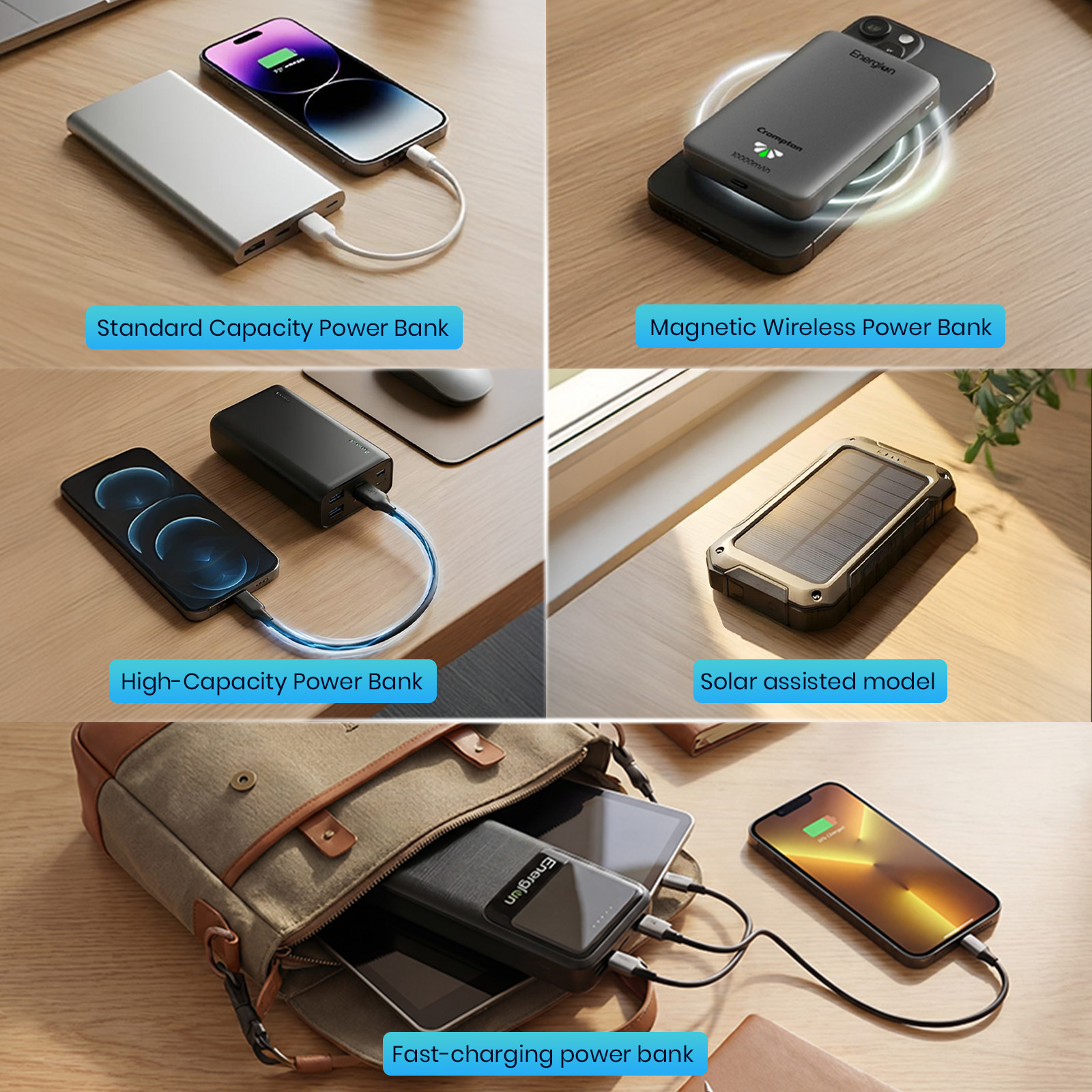
Portable charging has transitioned from being an add-on to an everyday necessity. Nowadays, phones handle payments, directions, meetings, tickets, and messages, so a low battery is no longer a minor inconvenience. It can interrupt work, delay travel or leave you disconnected when you need your device the most. That is why carrying a power bank today feels similar to keeping chargers, cables and other small home appliances ready for convenience at home.
The market offers many types of power banks; each designed for a different purpose. Some prioritise portability, some focus on speed and others aim for endurance. Picking the right option is less about the largest capacity and more about understanding how you actually use your device during the day.
What Is a Power Bank & Why Do You Need One?
A power bank is a portable rechargeable battery that stores electrical energy and transfers it to another device when required. Instead of depending on a fixed socket, you carry stored power with you and use it whenever necessary. Just as an extension board distributes electricity to multiple devices in a fixed location, a power bank does the same thing while you are on the move.
Modern smartphones handle heavy applications continuously, and ‘battery anxiety’ is a common experience. A power bank solves this quietly, no searching for sockets in crowded places and no waiting near charging points.
For many users, it stops being an emergency backup and becomes part of daily carry, much like keys or earphones. Once you get used to having reliable backup power, it is difficult to go back.
How Do Power Banks Differ?
At first glance, most power banks appear similar, with rectangular bodies, ports and indicator lights. In practice, the kinds of power bank vary widely in design and purpose. Capacity, charging speed, portability and connection style all create noticeable differences in everyday usage.
Some are designed to be compact and easy to carry, while others are designed to support multiple devices for long travel days. You also have cable-free options and outdoor-friendly designs. Knowing about these categories helps you make the right choice as per your requirement.
What Are the Different Types of Power Banks?
|
Compact pocket power bank |
Emergency backup |
Lightweight carry |
Short daily commute |
|
Standard capacity power bank |
Regular use |
Balanced performance |
Work or college day |
|
High-capacity power bank |
Extended backup |
Multiple device charges |
Travel & long trips |
|
Wireless / magnetic |
Cable-free charging |
Convenience |
Minimal carry users |
|
Fast-charging power bank |
Quick charging |
Saves time |
Busy routines |
|
Solar assisted model |
Outdoor support |
Alternative recharge option |
Outdoor travel |
|
Multi-device charger |
Several outputs |
Charges multiple gadgets |
Families & professionals |
A compact power bank is easy to carry but offers limited charging capacity. A larger unit will last longer but add weight. Wireless options improve comfort while fast-charging units reduce waiting time. Each serves a different lifestyle rather than competing directly.
How to Choose the Right Type of Power Bank for Your Needs?
Choosing the right power bank from different types of power bank starts with understanding your requirement rather than comparing specifications alone.
Lightweight Models
If your routine mainly includes commuting between home and office, a lightweight model works well. It handles unexpected battery drops without making your bag heavier. These models are ideal for students and office users for whom portability matters more than maximum capacity.
Mid-capacity Models
For people who use navigation, calls or are streaming throughout the day, a mid-capacity option is more suitable. It charges the phone comfortably once and still remains easy to carry.
Travel Power Banks
Frequent travellers require longer endurance. Airports, road trips and outdoor meetings don’t usually have predictable charging access. In such cases, a power bank for travel that has a higher capacity proves practical. It allows multiple top-ups and reduces dependency on public charging points.
MagSafe Power Bank
Some users prefer convenience over cables. The MagSafe power bank meaning is a magnetic wireless charging unit that attaches directly to compatible phones. You simply place the phone on the power bank and charging begins automatically, which reduces cable clutter.
Solar Power Bank
Outdoor enthusiasts may notice another category. A solar power bank explained means the device can be slowly recharged using sunlight. This feature serves as a backup in case you don’t have access to electricity.
Power Bank Selection Guide Summary
-
For short daily commutes, use a compact portable option
-
For moderate daily usage, use a standard capacity model
-
For long journeys, use a high-capacity travel power bank
-
If you are convenience-focused, use a magnetic wireless charger
-
For outdoor backup, go for a solar-assisted charging model
Selecting according to routine prevents unnecessary weight and improves practicality.
Key Factors to Compare Before Buying Power Bank
Before deciding among different types of power banks, it helps to look beyond just the capacity number and understand how the device will perform in daily use. A practical choice balances performance, safety and portability rather than focusing on a single specification.
-
Battery capacity suitable for usage pattern - Choose based on how often you need backup, not just the biggest number available
-
Charging speed and output stability - Ensures faster and consistent charging without stressing your device battery
-
Number of available ports - Helpful if you regularly charge more than one device
-
Compatibility with your devices - Check cable type and supported charging standards
-
Weight and comfort of carrying - A bulky power bank is less likely to be carried daily
-
Recharge time of the power bank - Important for users who depend on it every day
-
Safety protection circuits – Safeguards both the power bank and connected devices
-
Build quality and finish - Durability is important for regular handling
-
Battery level indicators - Helps you be prepared to recharge in advance
-
Heat and surge protection - Prevents overheating and voltage fluctuation damage
A balanced specification often delivers a far smoother experience than simply choosing the largest battery capacity.
Power Banks Provide Effortless Everyday Reliability
A suitable power bank is one you hardly notice carrying, yet value whenever your battery runs low. When chosen thoughtfully, it fits seamlessly into daily life, offering dependable backup without inconvenience, keeping your devices active while allowing you to focus on work, travel, or communication without interruption.
FAQs on Types of Power Banks
What power bank capacity should I buy?
It depends on how often you use your phone. Light users can manage with a smaller capacity, while travellers and heavy users benefit from a larger backup capacity for longer use without having to search for a socket or extension board.
What are main differences in different portable charger types?
Portable chargers mainly differ by capacity, charging speed and connection method. Some prioritise portability, others fast charging and some add wireless or outdoor charging support. Each type suits a specific routine rather than replacing all others.
 Read Previous Blog

 at 9228880505 or write to us at
