


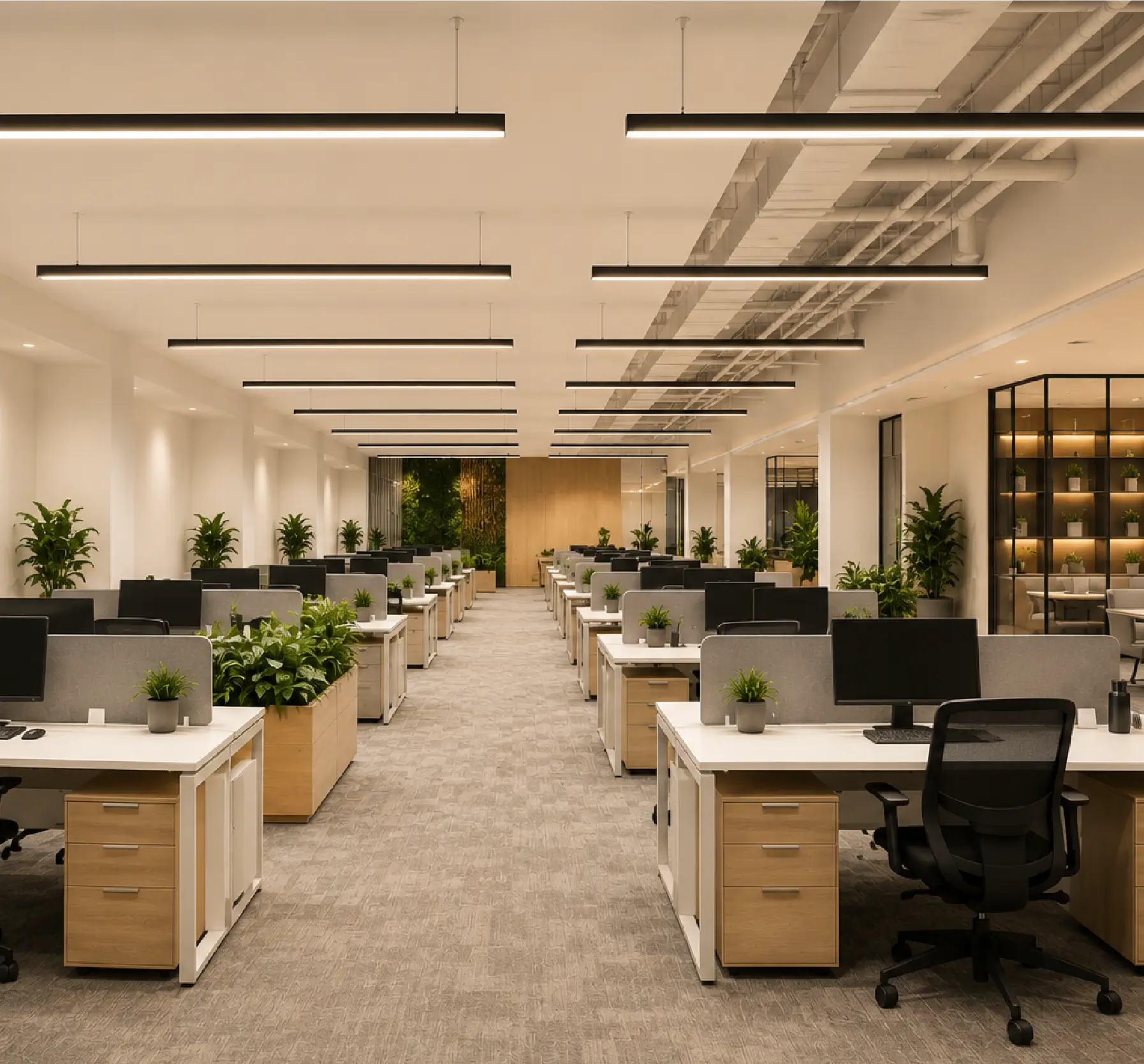
Reducing Eye Strain in Office Environments with Linear Lighting and Anti-Glare Fixtures
Lighting has become a critical factor in workplace comfort and productivity. Poor illumination, excessive glare, and uneven light distribution can contribute to visual fatigue and reduced concentration. Incorporating linear LED lighting for offices and anti glare office lighting creates a more comfortable visual environment by delivering uniform illumination with minimal glare. This guide explores practical office lighting solutions to reduce eye strain and improve workplace wellbeing while supporting modern commercial office lighting design.
What Causes Eye Strain in Office Environments?
Eye strain in office environments is commonly caused by prolonged screen exposure combined with inadequate lighting conditions. Excessively bright luminaires, direct glare, reflections on monitors, uneven illumination, and insufficient task lighting force the eyes to work harder, resulting in discomfort, headaches, and reduced focus. Many professionals often wonder why do office lights cause eye fatigue, and the answer lies in poor lighting design rather than brightness alone. Factors such as incorrect luminaire placement, high glare ratings, and inconsistent light distribution can all contribute to office eye strain lighting issues.
Implementing ergonomic office lighting solutions with balanced illumination and glare control helps create a more comfortable and visually supportive workplace.
Why Office Lighting Matters for Visual Comfort and Productivity?
Lighting plays a significant role in creating a comfortable and efficient work environment.
Well-designed office lighting supports visual clarity, minimises eye fatigue, and helps employees remain focused throughout the workday. In contrast, poor lighting can increase visual discomfort, reduce concentration, and negatively affect workplace performance. Integrating office lighting for productivity and comfort with appropriate illumination levels and glare control creates healthier, more engaging workspaces.
Key benefits include:
- Reduces visual fatigue by providing balanced, uniform illumination.
- Minimises reflections and glare on computer screens through office lighting to reduce glare.
- Supports better concentration and sustained employee productivity.
- Improves visual comfort in collaborative, individual, and meeting spaces.
- Creates a more pleasant working environment with energy-efficient office lighting.
- Forms the foundation of effective eye strain office lighting solutions for modern workplaces.
What Is Linear Lighting for Offices?
Linear lighting refers to lighting systems that use elongated luminaires to provide continuous, uniform illumination across a workspace. Unlike conventional point-source lighting, linear fixtures distribute light evenly, reducing shadows and brightness variations that can contribute to visual discomfort. Linear LED lighting for offices is widely used in open-plan workspaces, meeting rooms, reception areas, corridors, and collaborative spaces, where consistent illumination is essential. Available in suspended, recessed, surface-mounted, and
continuous-run configurations, linear lighting offers both functional performance and architectural appeal. Its versatility makes it a preferred choice in commercial office lighting design, combining energy efficiency with a clean, contemporary aesthetic.
What Are Anti-Glare Lighting Fixtures?
Anti-glare lighting fixtures are specially designed luminaires that minimise direct glare and uncomfortable brightness, creating a more comfortable visual environment for occupants. They achieve this through optical components such as diffusers, lenses, that distribute light evenly while reducing harsh light output. Anti glare office lighting is particularly beneficial in offices where employees spend extended hours working on computers or reading documents. By improving visual comfort and reducing reflections on screens, anti glare fixtures for workplaces contribute to healthier workspaces and help organisations implement effective office lighting solutions to reduce eye strain.
How Anti-Glare Fixtures Help Reduce Visual Discomfort?
Proper glare control is one of the most effective ways to improve workplace visual comfort. How anti glare lighting reduces eye strain can be understood through the following benefits:
- Reduces direct glare from overhead luminaires
- Minimises reflections on computer monitors and glossy work surfaces
- Creates uniform illumination without harsh brightness contrasts
- Supports comfortable viewing during prolonged screen use
- Reduces frequent eye refocusing caused by uneven lighting
- Improves visual clarity for reading, writing, and detailed tasks
- Enhances employee comfort and reduces complaints related to office eye strain lighting
- Contributes to healthier and more productive office environments using glare free lighting fixtures for offices
Benefits of Linear Lighting in Modern Office Spaces
Modern linear lighting combines aesthetics with functionality, making it ideal for today's workplace environments.
- Provides continuous, uniform illumination across workspaces.
- Reduces shadows and uneven brightness that contribute to eye fatigue.
- Supports flexible lighting layouts for open offices and collaborative spaces.
- Enhances architectural aesthetics with clean, minimalist designs.
- Available in suspended, recessed, surface-mounted, and continuous configurations.
- Offers multiple lengths, wattages, and colour temperature options for varied applications.
- Delivers reliable energy-efficient office lighting with long operational life.
- Integrates seamlessly into contemporary commercial office lighting design while supporting employee comfort.
Linear Lighting vs Traditional Office Lighting
| Parameter | Linear Lighting | Traditional Office Lighting |
| Light Distribution | Continuous and uniform illumination | Localised illumination with noticeable bright spots |
| Visual Comfort | Reduced glare and balanced brightness | Higher risk of glare and uneven lighting |
| Workspace Appearance | Sleek, contemporary architectural design | Conventional fixture appearance |
| Flexibility | Available in multiple layouts and continuous runs | Limited design flexibility |
| Energy Efficiency | High-performance LED technology with lower power consumption | Generally less efficient depending on fixture type |
| Maintenance | Longer lifespan and lower maintenance requirements | More frequent replacement and maintenance |
Best Lighting Practices to Reduce Eye Strain in Offices
Creating a visually comfortable workplace requires a combination of appropriate lighting levels, glare control, and thoughtful fixture selection.
- Choose anti glare office lighting solutions for screen-intensive workspaces.
- Use uniform ambient lighting to eliminate excessive brightness contrasts.
- Position luminaires to minimise reflections on computer monitors.
- Combine ambient and task lighting where detailed work is performed.
- Select appropriate colour temperatures suited to office environments.
- Ensure lighting levels comply with workplace illumination recommendations.
- Use high-quality LED luminaires with controlled optical performance.
- Incorporate daylight where possible while controlling excessive sunlight.
- Implement lighting controls to adjust illumination based on occupancy and daylight.
- Regularly maintain fixtures to preserve lighting quality and performance.
- Adopt ergonomic office lighting solutions that prioritise employee comfort.
- Review lighting layouts periodically to ensure continued visual comfort.
Recommended Lighting Solutions for Different Office Areas
| Office Area | Recommended Lighting Solution |
| Open Workstations | Suspended or recessed linear LED lighting for offices with glare-controlled optics. |
| Meeting Rooms | Dimmable linear lighting with balanced ambient illumination. |
| Reception Areas | Decorative linear luminaires that combine aesthetics with functional lighting. |
| Executive Cabins | Layered lighting using ambient and task illumination. |
| Collaboration Spaces | Uniform linear lighting with adaptable brightness levels. |
| Corridors | Continuous linear fixtures for consistent navigation lighting. |
| Pantry & Breakout Areas | Comfortable warm-white lighting that promotes relaxation. |
How to Choose the Right Office Lighting Fixtures?
Step 1: Assess the function of each office space and its lighting requirements. Step 2: Determine appropriate illumination levels based on workplace activities. Step 3: Select anti-glare office light fixtures with effective optical control.
Step 4: Choose linear luminaires that provide uniform illumination and design flexibility.
Step 5: Consider fixture mounting options such as recessed, suspended, or surface-mounted installations.
Step 6: Select suitable wattage, colour temperature, and lumen output.
Step 7: Prioritise energy-efficient office lighting with long service life and low maintenance requirements.
Step 8: Incorporate intelligent lighting controls for enhanced efficiency and user comfort.
Common Office Lighting Mistakes That Increase Eye Strain
- Using excessively bright luminaires without glare control.
- Poor fixture placement causing reflections on computer screens.
- Uneven lighting that creates dark spots and excessive brightness contrasts.
- Relying solely on overhead lighting without task lighting.
- Selecting inappropriate colour temperatures for office work.
- Ignoring employee visual comfort during lighting design.
- Failing to use anti glare office lighting in screen-intensive workspaces.
- Neglecting regular maintenance results in reduced lighting performance.
Crompton Linear and Anti-Glare Lighting Solutions for Offices
Crompton's lighting solutions are designed to create comfortable, visually balanced workplaces while complementing contemporary office architecture. Combining performance, flexibility, and aesthetics, Crompton's linear luminaires deliver uniform illumination with effective glare control, making them ideal anti glare office lighting solutions for modern workspaces. Designed for offices, educational institutions, commercial facilities, and collaborative environments, these luminaires support employee well-being while enabling efficient, adaptable lighting layouts.
Featured Product – CromLine Linear Luminaire
- Premium extruded aluminium housing available in elegant black and white finishes.
- Standard and prismatic diffuser options for soft ambient lighting and glare-controlled task illumination.
- Supports office lighting to reduce glare and improve visual comfort during prolonged screen use.
- Available in multiple lengths, wattages, and CCT options to suit different workspace requirements.
- Supports suspended, standalone, and continuous connected installations for design flexibility.
- Top-accessible driver compartment with loop-in/loop-out wiring for simplified installation and maintenance.
- Delivers reliable energy-efficient office lighting with consistent illumination for modern office environments.
Office Lighting Checklist for Reducing Eye Strain
- Provide uniform ambient illumination throughout the workspace
- Install anti glare office lighting in screen-intensive areas
- Minimise reflections on computer monitors
- Use linear lighting for consistent light distribution
- Select appropriate colour temperatures for office tasks
- Incorporate task lighting where required
- Choose high-efficiency LED luminaires
- Implement lighting controls for daylight and occupancy
- Maintain fixtures regularly to ensure optimal lighting performance
FAQs on Office Lighting, Eye Strain and Anti-Glare Fixtures
Q. How can office lighting reduce eye strain?
A. Balanced illumination, effective glare control, and uniform light distribution reduce visual fatigue, minimise screen reflections, and improve overall workplace comfort.
Q. What type of lighting is best for office workspaces?
A. Linear LED lighting for offices combined with glare-controlled fixtures provides consistent illumination, making it ideal for modern work environments.
Q. Are anti-glare lights good for office environments?
A. Yes. Anti glare office lighting helps reduce direct glare and screen reflections, creating a more comfortable visual environment for employees.
Q. How do linear lighting fixtures improve office comfort?
A. Linear fixtures distribute light evenly across workspaces, reducing shadows, brightness contrasts, and visual fatigue while enhancing workplace aesthetics.
Q. What is the ideal lighting level for office spaces?
A. Lighting levels vary depending on the workspace and task, but they should provide sufficient illumination with minimal glare while complying with applicable office lighting standards.
Q. How does poor office lighting affect employee productivity?
A. Poor lighting can cause eye strain, headaches, reduced concentration, increased fatigue, and lower overall workplace productivity.
Q. What are the benefits of using anti-glare LED fixtures in offices?
A. They improve visual comfort, reduce glare and reflections, support prolonged screen use, lower energy consumption, and contribute to healthier, more productive workplaces.


