


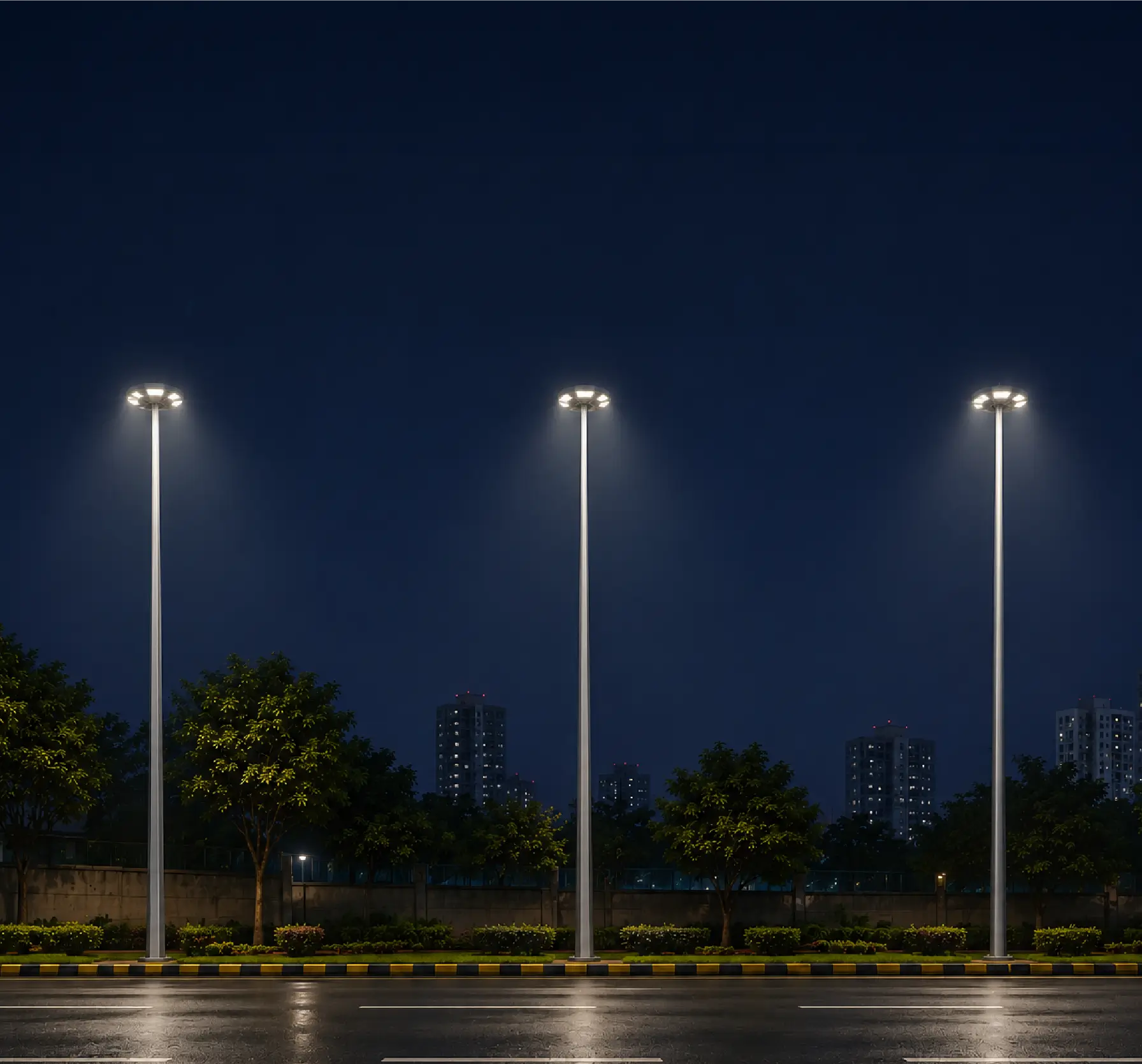
Octagonal vs Conical vs Round Poles: Shape Selection Guide for Lighting Projects
When planning a lighting project, most people think about brightness and cost. But there's something equally important that often gets overlooked: the shape of the pole itself. Seems like a small detail, right? Actually, whether you choose octagonal vs conical vs round poles significantly impacts strength, wind resistance, appearance, and long-term costs. This guide walks you through the difference between octagonal conical and round poles, helping you understand which shape works best for your specific situation. We'll compare structural strength, wind performance, looks, and manufacturing factors, everything you need to make a confident decision.
What Are Octagonal, Conical and Round Lighting Poles?
Before we compare, let's understand what we're talking about. These three shapes represent the most common designs in outdoor and infrastructure lighting:
Round poles are cylindrical, exactly what most people picture when they imagine a lighting pole. They're uniform in diameter from top to bottom, delivering a classic look used everywhere from residential streets to industrial yards.
Octagonal poles have eight sides (imagine a cylinder with eight flat faces instead of a curved surface). They taper slightly from bottom to top, creating a distinctive geometric appearance. You'll spot them increasingly in modern designs.
Conical poles taper smoothly from a wider base to a narrower top, creating a cone-like shape. They're the least common of the three but offer unique performance characteristics that matter for specific applications.
Each shape represents a different engineering approach to solving the same problem: supporting lights safely while resisting wind, managing weight, and looking professional.
Why Pole Shape Matters in Lighting Design?
Choosing pole shape isn't cosmetic; it affects core performance and costs. Here's why this decision matters:
- Structural Performance: Different shapes distribute forces differently. Some resist bending better; others handle twisting forces more effectively
- Wind Resistance: Shape dramatically affects how poles withstand wind. A poorly shaped pole in a windy location might fail; the right shape works reliably
- Material Efficiency: Some shapes use less steel to achieve the same strength. That means lower cost and environmental benefits
- Aesthetics: Street appearance influences how communities perceive infrastructure. A thoughtfully chosen pole shape enhances neighbourhood character
- Manufacturing Process: Shape determines how poles are fabricated, which affects cost, lead times, and quality control
- Installation and Foundation: Pole shape influences foundation requirements and installation complexity, directly affecting project costs
- Maintenance Access: Some shapes are easier to inspect and service than others, affecting lifetime costs
Getting this right means a pole that works beautifully, reliably, and economically for 20-30 years.
Octagonal vs Conical vs Round Poles:
Structural Strength Comparison
|
Characteristic |
Octagonal Poles |
Conical Poles |
Round Poles |
|
Bending Strength |
High (geometric sides provide resistance) |
High (taper distributes loads smoothly) |
Good (uniform but less efficient) |
|
Torsional Strength |
Very High (flat surfaces resist twisting) |
Moderate (smooth taper less effective for twisting) |
Good (uniform distribution) |
|
Material Efficiency |
Excellent (achieves strength with less steel) |
Excellent (taper reduces unnecessary material) |
Good (uniform but less efficient) |
|
Load Distribution |
Excellent (geometric design spreads forces) |
Excellent (smooth taper, gradual) |
Adequate (uniform distribution) |
|
Durability Under Stress |
Very Good (proven in extreme conditions) |
Very Good (smooth design resists fatigue) |
Good (reliable, well-understood) |
|
Typical Safety Factor |
2.5-3.0x |
2.5-3.0x |
2.0-2.5x |
Octagonal poles and conical poles typically require less steel to achieve equivalent strength compared to round poles. This isn't just theoretical; it translates to real advantages in engineering, cost, and environmental impact.
Wind Resistance of Octagonal, Conical and Round Poles
Wind performance is where pole shape truly shows its value. Here's what you need to understand:
- Octagonal Design Advantage: Flat surfaces naturally deflect wind more effectively than curved surfaces. Wind doesn't "grab" smooth curves the same way. This is why octagonal poles perform exceptionally well in high-wind areas
- Conical Smooth Taper: The gradual taper from base to top reduces turbulence and vortex formation. Wind flows along the pole smoothly rather than creating chaotic pressure zones
- Round Pole Behavior: Curved surfaces create vortex shedding wind wraps around the smooth curve, creating low-pressure zones that create forces the pole must resist. In strong winds, this becomes problematic
- Real-World Performance: In coastal areas, high mountains, and exposed locations, wind resistance for high mast poles is critical. Octagonal and conical designs outperform round poles in these situations
- Fixture Load Effects: Larger fixture loads amplify wind forces. Conical and octagonal shapes handle fixture-induced wind forces more efficiently
For high-wind applications in coastal regions, mountain passes, and exposed industrial areas, octagonal or conical poles are the smart engineering choice. They'll withstand what round poles might struggle with, all while using potentially less material.
Aesthetic Differences Between Octagonal, Conical and Round Poles
|
Visual Aspect |
Octagonal Poles |
Conical Poles |
Round Poles |
|
Modern Appeal |
High (contemporary geometric look) |
High (elegant, flowing lines) |
Medium (classic, traditional) |
|
Street Character |
Progressive, designed, intentional |
Sophisticated, fluid, refined |
Familiar, conventional, ubiquitous |
|
Integration with Modern Architecture |
Excellent (complements modern design) |
Very Good (elegant transition from base to top) |
Good (neutral, adapts to surroundings) |
|
Visibility in Landscape |
More prominent (geometric presence) |
Elegant without dominating |
Visually recessive (blends in) |
|
Colour/Finish Visibility |
Shows finishes well (flat surfaces reflect light) |
Shows gradation beautifully (taper emphasises shaping) |
More uniform appearance (harder to emphasise details) |
|
Community Perception |
Modern, updated, investment in quality |
Refined, professional, considered |
Practical, functional, traditional |
When communities upgrade street lighting, the shape of the poles influences how people perceive the project. Octagonal poles say "we invested in quality." Conical poles project sophistication. Round poles communicate practicality and reliability.
Manufacturing Considerations for Different Pole Shapes
Different shapes mean different manufacturing approaches, which affect cost and availability:
- Octagonal Manufacturing: Fabrication involves rolling steel, cutting, and welding flat sections together. Equipment and labour requirements are moderate. Lead times are typically 4-8 weeks. Quality control is straightforward and geometrically consistent
- Conical Process: Requires specialised tapering equipment and skilled welders. More complex manufacturing, typically with 6-10 week lead times. Each pole requires precise tapering, making quality control more involved but achievable
- Round Pipe Production: Straightforward manufacturing using standard pipe rolling equipment. Widely available, 2-4 week lead times. Equipment is common and affordable, making competition high and pricing favourable
Manufacturing guide for lighting poles shows that round poles offer the easiest, fastest, and most economical production. Octagonal and conical poles require more specialised equipment and skill but deliver superior performance and aesthetic benefits worth the premium.
When to Choose Octagonal Lighting Poles?
Octagonal poles shine in specific situations where their advantages matter most: Choose octagonal when:
- Wind is a concern: Coastal areas, high elevation, and exposed locations where strong winds are common
- Modern aesthetics matter: Upgrading downtown areas, new development projects, and communities seeking a contemporary appearance
- Structural efficiency counts: Projects where reducing material cost and weight is important
- High-load fixtures: Supporting heavy LED clusters or multiple fixtures where structural strength matters
- Long-term reliability: Projects where durability under stress justifies premium materials
- Twisting forces present: Areas with irregular wind patterns or complex terrain, creating variable wind directions
Octagonal poles cost 10-15% more than equivalent round poles but deliver genuinely superior performance in challenging conditions.
When to Choose Conical Lighting Poles?
Conical poles offer elegance and performance in their own way:
Select conical poles when:
- Elegance is essential: Premium projects, upscale neighbourhoods, architectural landmarks
- Wind performance needed: Better than round for exposed areas, though not quite as strong as octagonal for extreme conditions
- Visual tapering matters: Where the gradual narrowing from base to top creates a desired aesthetic effect
- Material efficiency is important: Conical design uses less steel while maintaining structural integrity
- Smooth aesthetic lines desired: Curves appeal more than geometric facets; some design sensibilities prefer conical grace
Conical poles cost 15-20% more than round but deliver sophistication that justifies the premium in appropriate applications.
When to Choose Round Lighting Poles?
Round poles remain the practical, economical choice for many applications: Use round poles when:
- Budget is the primary consideration: Cost-conscious projects where premium materials aren't justified
- Standard applications: Typical street lighting, residential areas, industrial yards without extreme conditions
- Rapid installation needed: Wide availability means quick delivery, and multiple installation contractors are familiar with them
- Simplicity preferred: No special equipment or expertise required for inspection, maintenance, or repair
- Standard performance adequate: Wind loads and loads within normal engineering parameters
- Community expectations traditional: Areas where conventional poles match neighbourhood character
Round poles represent decades of proven, reliable performance. They work well for straightforward applications where premium features aren't necessary.
Best Applications for Each Pole Shape
| Application Type | Best Choice | Why This Shape Works | Secondary Option |
|---|---|---|---|
| Street Lighting – Standard | Round | Cost-effective, familiar, sufficient | Octagonal (if modern) |
| Coastal/Windy Areas | Octagonal | Superior wind resistance | Conical (for style + performance) |
| High-End/Modern Downtown | Octagonal or Conical | Aesthetic impact, durability | Premium Round |
| Industrial Yards | Octagonal | Heavy fixtures, durability | Round (standard duty) |
| Residential Areas | Round | Economical, appropriate | Octagonal (upgraded appearance) |
| Sports Fields/High Mast | Octagonal | Structural strength, stability | Conical (elegance + strength) |
| Historic Districts | Round | Maintains traditional character | Custom/Specialty shapes |
| Port/Shipping Facilities | Octagonal or Conical | Extreme wind, heavy equipment | Round (basic duty areas) |
| Airport Approach Lighting | Octagonal | Reliability, strength | Conical (performance + aesthetics) |
| Premium Residential/Golf | Conical | Elegance and performance | Octagonal (stronger wind areas) |
Cost and Maintenance Factors by Pole Shape
| Factor | Octagonal | Conical | Round |
|---|---|---|---|
| Initial Cost | 10–15% premium | 15–20% premium | Baseline |
| Foundation Requirements | Moderate | Moderate | Standard |
| Installation Time | Standard | Standard | Standard |
| Maintenance Complexity | Simple (geometric surfaces) | Simple (smooth surfaces) | Very Simple |
| Painting/Finishing | Standard (flat surfaces easier) | Standard (smooth coat) | Standard |
| Inspection Ease | Easy (geometric patterns aid assessment) | Moderate (smooth taper requires care) | Easy (uniform surfaces) |
| Repair Difficulty | Moderate (requires geometric precision) | Moderate (taper precision needed) | Simple (standard parts) |
| Corrosion Resistance | Equal (material-dependent) | Equal (material-dependent) | Equal (material-dependent) |
| Lifespan | 25–30+ years | 25–30+ years | 20–25 years |
Octagonal and conical poles cost more upfront but often justify the investment through superior durability and performance. Round poles offer immediate cost savings but may require replacement earlier in extreme environments.
How to Choose the Right Pole Shape for Your Lighting Project
Selecting the right shape requires understanding your specific situation:
Step 1: Assess Environmental Conditions: Wind exposure, salt air, temperature extremes, seismic activity. These environmental factors heavily influence which shape performs best.
Coastal projects demand different thinking than inland installations.
Step 2: Define Structural Requirements: How heavy are your fixtures? How tall is the pole? What loads will it carry? Heavier, taller installations benefit more from octagonal or conical design efficiency.
Step 3: Consider Aesthetic Goals: Will the poles be focal points or background infrastructure? Modern neighbourhoods might embrace octagonal geometry. Traditional areas might prefer round poles' familiarity.
Step 4: Evaluate Budget Constraints: What premium can you justify? If environmental conditions demand superior performance, an octagonal or conical make sense. If conditions are benign, round poles offer excellent value.
Step 5: Review Local Standards: Some regions have preferences or requirements. Check with local authorities about standard practices and any specifications that influence selection.
Step 6: Consult with Engineers: Professional engineers analyse your specific situation, location, loads, wind data, soil conditions and recommend the shape that delivers optimal performance and value. Their expertise prevents costly mistakes.
Common Mistakes to Avoid When Selecting Lighting Poles
Even experienced projects sometimes stumble with pole selection. Avoid these errors:
- Ignoring Wind Data: Choosing round poles in a high-wind area without wind engineering analysis invites problems
- Underestimating Load: Not accounting for fixture weight, ice accumulation, or future upgrades leads to inadequate structural capacity
- Pure Cost Focus: Selecting round poles for coastal projects purely to save money ignores the superior performance of octagonal poles
- Aesthetic Mismatch: Choosing octagonal poles in traditional neighbourhoods or round ones in modern areas creates disconnects
- Neglecting Foundation Design: Pole shape affects foundation needs. Poor foundation planning creates structural problems later
- Ignoring Maintenance Needs: Selecting shapes that require specialised maintenance in areas lacking trained technicians
- No Future Planning: Not considering whether future fixture upgrades might need stronger poles
Crompton Lighting Pole Solutions
for Outdoor and Infrastructure Projects For octagonal conical round lighting poles selection and installation, engineering expertise matters enormously. Crompton offers comprehensive solutions across all three designs:
- Octagonal Pole Specialists: High-performance octagonal designs for extreme wind conditions and heavy-duty applications
- Conical Elegance Series: Sophisticated conical options delivering performance and aesthetic refinement
- Premium Round Solutions: High-quality round poles engineered for reliability across standard applications
- Material Options: Steel, aluminium, and composite materials matching environmental conditions and budget
- Custom Engineering: Designs tailored to your specific site conditions, loads, and performance requirements
- Complete Installation Support: From foundation design through final installation, comprehensive project support
- Maintenance Programs: Long-term support ensuring optimal performance throughout the pole's lifespan
Crompton's expertise with high mast pole shape comparison ensures you select the right shape first time, delivering years of reliable performance.
Lighting Pole Shape Selection Checklist
Before finalising your pole shape selection, verify these essentials:
- Environmental Assessment: Wind speeds, salt air exposure, temperature extremes, and seismic risk documented
- Load Calculations: Fixture weight, ice accumulation, and future upgrades are all accounted for
- Wind Engineering Analysis: Professional assessment of wind forces and pole performance in actual site conditions
- Soil Investigation: Foundation requirements determined through soil testing and analysis
- Aesthetic Objectives: Clear vision of desired appearance and community character matching
- Budget Parameters: Total installed cost understood, including foundation and installation labour
- Maintenance Capabilities: Local availability of maintenance expertise for selected pole type
- Code Compliance: All designs meeting electrical, structural, and safety codes
- Corrosion Strategy: Material selection and protective coatings appropriate for the environment
- Professional Review: Engineering assessment confirming design appropriateness
- Timeline Confirmation: Delivery and installation schedule meeting project needs
- Long-term Plan: Consideration of future modifications or upgrades
FAQs:
Q1: What is the difference between octagonal, conical and round poles?
Ans: Round poles are cylindrical with uniform diameter top to bottom. Octagonal poles have eight flat sides and a slight taper. Conical poles taper smoothly from a wide base to a narrow top. Each shape affects structural strength, wind resistance, and appearance differently. Octagonal and conical are generally more efficient; round is more economical.
Q2: Which pole shape is best for street lighting applications?
It depends on conditions. Standard neighbourhoods: round poles offer cost-effective reliability. Modern developments: octagonal poles provide a contemporary appearance and durability. Coastal areas: Octagonal poles handle wind better. Budget-conscious: round poles deliver great value for standard conditions.
Q3: Are octagonal poles stronger than round poles?
Ans: For equivalent material weight, octagonal poles are structurally superior, as they achieve greater strength through better geometric efficiency. However, an over-engineered round pole can match an octagonal pole's strength while using more material and costing more.
Q4: Which lighting pole shape offers better wind resistance?
Ans: Octagonal poles handle wind best through flat-surface geometry that deflects forces effectively. Conical poles offer good wind performance through smooth tapering that reduces vortex formation. Round poles are adequate for standard winds but struggle in extreme conditions.
Q5: How do you choose the right pole shape for outdoor lighting?
Ans: Assess environmental conditions (wind, salt, temperature), define structural requirements (height, fixture loads), clarify aesthetic goals, evaluate budget, check local standards, and consult engineers who analyse your specific situation to recommend the optimal shape.
Q6: What are the advantages of octagonal poles in lighting projects?
Ans: Superior wind resistance (critical for coastal/exposed areas), excellent structural efficiency (achieves strength with less material), modern aesthetic appeal, proven durability in extreme conditions, and exceptional performance with heavy fixture loads.
Q7: Which is better for high mast and street lighting: octagonal, conical or round poles?
Ans: High mast with heavy fixtures: octagonal poles deliver superior strength and wind performance. Modern street lighting: octagonal for wind-prone areas or contemporary aesthetics. Standard street duty: round poles offer cost-effective reliability. Upscale applications: conical poles balance performance and elegance.


