


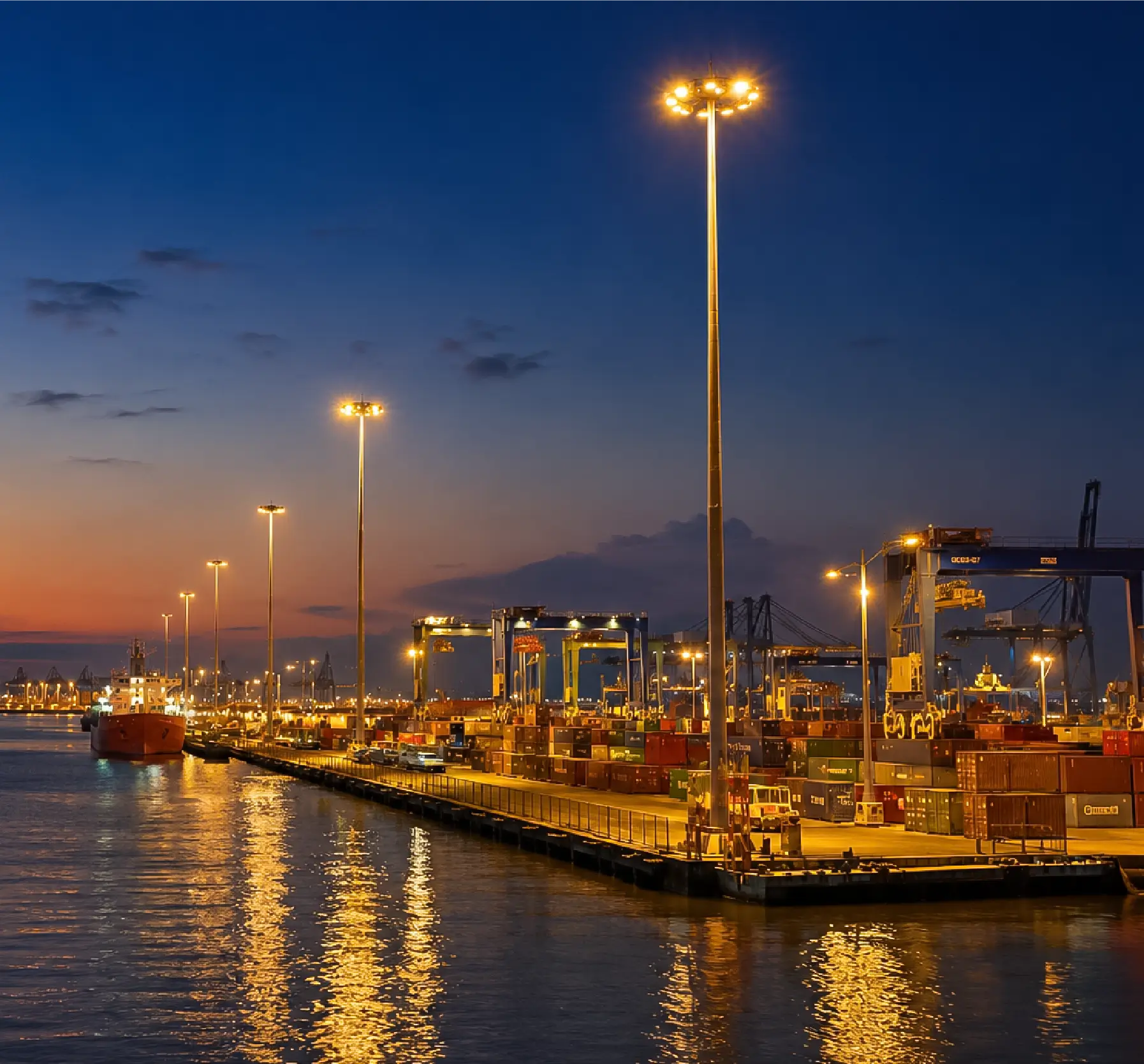
Complete Guide to High Mast Lighting: Everything You Need to Know
High mast lighting is an advanced outdoor illumination system designed to provide uniform lighting across large open spaces using tall poles fitted with multiple high-performance luminaires. Commonly used for highways, airports, ports, industrial facilities, stadiums, and logistics parks, these systems enhance visibility, safety, and operational efficiency while minimising the number of poles required. This high mast lighting guide explains what is high mast lighting, its working principle, components, applications, benefits, and key considerations to help you choose the right lighting solution for your project.
What Is High Mast Lighting?
What is high mast lighting? It is a lighting system that uses tall poles, typically ranging from 16 to 30 metres, to illuminate expansive outdoor areas from a single elevated point. Unlike conventional street lighting, high mast systems distribute light over a much wider area, reducing installation points while ensuring consistent illumination.
If you're wondering what is high mast light, it refers to the luminaire mounted at the top of the mast as part of the complete lighting system. Modern high mast lighting solutions combine robust mast structures with LED luminaires, raising and lowering mechanisms, and electrical control systems to deliver reliable, energy-efficient outdoor lighting.
How Does High Mast Lighting Work?
Understanding how does high mast lighting work helps in selecting the right system for different infrastructure projects. The lighting fixtures are mounted on a movable lantern carriage at the top of a high mast. A motorised raising and lowering mechanism allows the luminaire assembly to be safely lowered for maintenance without requiring elevated access equipment.
Key working principles include:
- Tall masts provide wide-area illumination with fewer poles.
- Multiple LED luminaires distribute light uniformly.
- Raising and lowering systems simplify servicing.
- Feeder pillars supply electrical power safely.
- Precision optics reduce glare while improving visibility.
- Smart controls can automate switching and monitoring.
Key Components of a High Mast Lighting System
A reliable system comprises several high mast lighting components, each engineered for structural integrity, operational safety, and long-term performance. Common industrial high mast light components include:
- High mast pole
- Lantern carriage
- LED luminaires
- Raising and lowering (R&L) mechanism
- Heavy-duty winch
- Stainless steel wire ropes
- Feeder pillar
- Foundation bolts
- Head frame assembly
- Lightning protection and earthing system
- Control panel
- Aviation lamp (where applicable)
High Mast Lighting Components and Their Functions
|
Component |
Function |
|
High mast pole |
Supports the complete lighting system at elevated heights. |
|
Lantern carriage |
Holds multiple luminaires securely. |
|
LED luminaires |
Deliver uniform, high-intensity illumination. |
|
Raising & lowering system |
Enables safe maintenance from ground level. |
|
Winch |
Raises and lowers the lantern carriage. |
|
Stainless steel wire ropes |
Support smooth lifting operations. |
|
Feeder pillar |
Supplies and distributes electrical power. |
|
Foundation bolts |
Secure the mast to the foundation. |
|
Earthing system |
Protects equipment against electrical faults. |
|
Aviation lamp |
Improves visibility for aircraft where required. |
Where Is High Mast Lighting Used?
The versatility of high mast lighting applications makes these systems suitable for large outdoor environments requiring dependable illumination.
|
Location |
Purpose |
|
Highways & Expressways |
Improved road visibility and traffic safety |
|
Airports |
Apron, runway surroundings and parking areas |
|
Ports & Harbours |
Cargo handling and operational safety |
|
Industrial Plants |
Continuous outdoor operations |
|
Logistics Parks |
Warehouse yards and loading bays |
|
Stadiums |
Sports and spectator visibility |
|
Railway Yards |
Safe rail operations |
|
Toll Plazas |
Enhanced driver visibility |
|
Parking Areas |
Vehicle and pedestrian safety |
|
Oil & Gas Facilities |
Secure illumination for critical infrastructure |
This wide range of high mast lighting applications demonstrates why these systems are preferred wherever extensive outdoor coverage is required.
Benefits of High Mast Lighting for Large Outdoor Areas
The advantages of high mast lighting extend beyond illumination, supporting safety, operational efficiency, and lower lifecycle costs.
- Wide-area illumination using fewer poles
- Uniform light distribution with reduced dark spots
- Enhanced visibility for vehicles and pedestrians
- Lower infrastructure and maintenance requirements
- Improved operational safety in industrial environments
- Better aesthetics with minimal visual clutter
- Long service life with LED technology
- Supports smart lighting integration
- Ideal for energy-efficient high mast lighting projects
- Suitable for highways, ports, airports, and industrial facilities
High Mast Lighting vs Street Lighting vs Flood Lighting
|
Parameter |
High Mast Lighting |
Street Lighting |
Flood Lighting |
|
Pole Height |
16–30 m |
6–12 m |
Variable |
|
Coverage Area |
Very Large |
Linear Roads |
Focused Areas |
|
Number of Fixtures |
Multiple |
Single |
Multiple |
|
Typical Application |
Highways, ports, airports |
Roads and streets |
Stadiums, facades, yards |
|
Maintenance |
Ground-level via R&L system |
Pole-mounted |
Fixture-specific |
|
Installation Cost |
Higher initially |
Moderate |
Application dependent |
|
Best For |
Large outdoor spaces |
Urban roads |
Targeted illumination |
High Mast Lighting Standards and Design Considerations
Compliance with high mast lighting standards is essential to achieve safe, reliable, and efficient illumination. Proper design considers factors such as mounting height, wind loading, structural stability, illumination levels, and maintenance accessibility. Adhering to high mast lighting regulations and internationally accepted engineering practices helps ensure long-term performance, structural safety, and reduced operational risks.
Key standards and regulations for high mast lights include:
- Design the mast to withstand the specified wind loads as per IS 875 (Part 3).
- Use structural steel conforming to BS EN 10025 or equivalent standards.
- Ensure hot-dip galvanisation for corrosion protection.
- Follow ILE lighting recommendations for illumination uniformity.
- Provide adequate earthing and lightning protection.
- Select a suitable foundation design based on soil conditions.
- Ensure luminaires meet the required IP and surge protection ratings.
- Include safe raising and lowering mechanisms for maintenance.
Key Factors to Consider Before Installing High Mast Lights
Installing the right system requires careful planning to maximise lighting performance and lifecycle value.
Step 1: Assess the site requirements, including area size, lighting objectives, and traffic movement.
Step 2: Select the appropriate mast height and luminaire configuration based on coverage requirements.
Step 3: Evaluate soil conditions and foundation design for structural stability.
Step 4: Consider wind load, environmental conditions, and corrosion protection.
Step 5: Choose LED high mast lighting systems with high efficacy and long service life.
Step 6: Plan electrical infrastructure, feeder pillars, and control systems.
Step 7: Ensure future high mast lighting maintenance can be performed safely using raising and lowering mechanisms.
Common Mistakes to Avoid in High Mast Lighting Design
- Selecting an incorrect mast height for the application.
- Ignoring wind load calculations.
- Using poor-quality corrosion protection.
- Overlooking illumination uniformity and glare control.
- Choosing an inadequate foundation design.
- Installing oversized or undersized luminaires.
- Neglecting routine high mast lighting maintenance.
- Failing to comply with applicable standards.
LED High Mast Lighting for Energy Efficiency
Modern LED high mast lighting systems have transformed outdoor illumination by delivering higher efficacy, longer service life, and significantly lower energy consumption compared to conventional lighting technologies. These systems offer better optical performance while reducing maintenance costs, making them ideal for highways, ports, airports, industrial facilities, and logistics parks.
Benefits of energy-efficient high mast lighting include:
- Reduced energy consumption
- Longer operational life
- Lower maintenance costs
- Improved illumination uniformity
- Better colour rendering and visibility
- Instant switching without warm-up time
- Lower carbon footprint
- Compatibility with smart lighting controls
Smart Controls for High Mast Lighting Systems
Smart lighting technologies further improve operational efficiency by enabling real-time monitoring and automated lighting management.
Key capabilities include:
- Remote ON/OFF scheduling
- Adaptive dimming based on traffic or activity
- Energy consumption monitoring
- Fault detection and alerts
- Centralised lighting management
- Preventive maintenance planning
- Integration with smart city platforms
- Reduced operating costs
Crompton High Mast Lighting Solutions for Infrastructure and Industrial Projects
Crompton offers comprehensive high mast lighting solutions engineered for highways, airports, ports, industrial facilities, logistics parks, stadiums, and large public spaces. Designed for durability, structural strength, and ease of maintenance, Crompton high mast systems deliver dependable performance even in demanding outdoor environments. The range includes complete systems with raising and lowering mechanisms, heavy-duty winches, corrosion-resistant construction, and multiple mast height options to suit diverse infrastructure requirements.
Key solution highlights:
- 16 m, 20 m, 25 m and 30 m mast height options
- 20-sided tapered mast design for superior structural stability
- Hot-dip galvanised construction with 85/65-micron corrosion protection
- Wind resistance up to 180 km/h (225 km/h on request)
- Heavy-duty 750 kg raising and lowering winch
- Stainless steel wire rope system with torque limiter
- Complete system supply including feeder pillar, R&L mechanism, winch and finial
- Designed in accordance with ILE recommendations, IS 875 and BS EN 10025 standards
High Mast Lighting Installation and Maintenance Checklist
- Complete site survey and lighting calculations
- Verify foundation design and soil conditions
- Select appropriate mast height and luminaires
- Ensure proper earthing and lightning protection
- Confirm compliance with applicable standards
- Perform safe commercial high mast lighting installation
- Test raising and lowering mechanism
- Inspect electrical connections
- Schedule periodic high mast lighting maintenance
- Monitor lighting performance and structural condition
FAQs on High Mast Lighting
Q. What is high mast lighting?
A. What is high mast lighting refers to a lighting system that uses tall masts fitted with multiple luminaires to illuminate large outdoor areas efficiently with fewer poles.
Q. What height is considered high mast lighting?
A. High mast lighting systems are generally installed at heights ranging from 16 to 30 metres, depending on the application and required lighting coverage.
Q. What are the main components of a high mast lighting system?
A. The system includes a mast, lantern carriage, LED luminaires, raising and lowering mechanism, winch, feeder pillar, foundation bolts, wire ropes, and electrical control equipment.


