


Difference Between Ceiling Fans & Table Fans

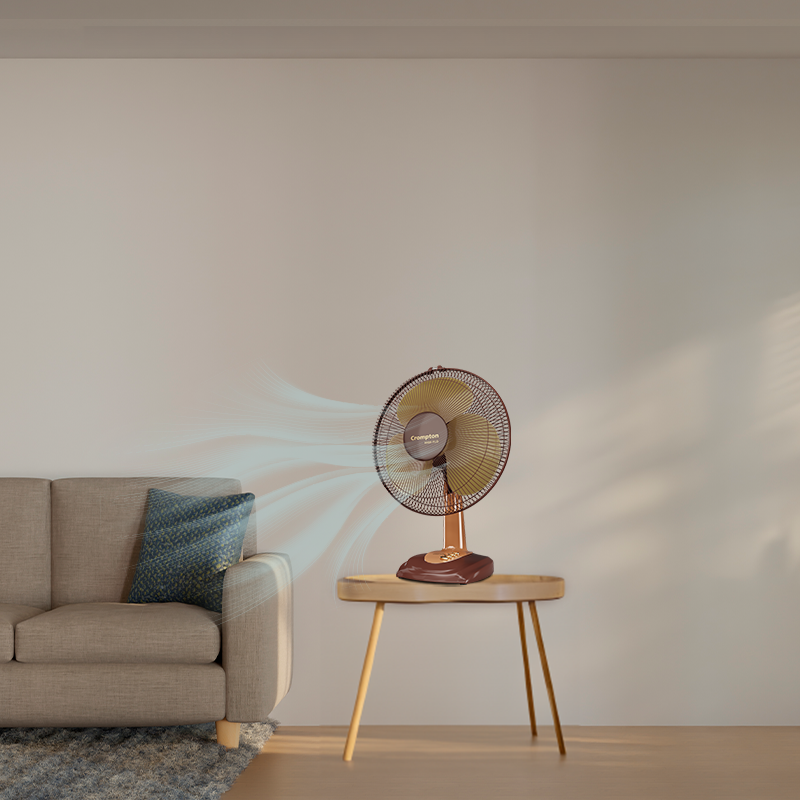
With a plethora of different fans available in the market today, you are bound to feel confused about which one will best fit your requirements. If you’re trying to choose between a ceiling fan and a table fan, we will give you a detailed understanding of the difference between ceiling fan and table fan.
Firstly, if you are wondering, “What is the difference between a ceiling fan and a table fan?” We will give you all the details about how a ceiling fan works and how a table fan works, a comparison of table fan vs ceiling fan, so you can understand what will fit your room and requirements best.
What is a Ceiling Fan and How Does It Work?
We’re sure you know what a ceiling fan is, but understanding the details of how a ceiling fan works will help you decide whether you need it or not.
When you turn on the ceiling fan, an electrical current flows through the motor and into wire coils wrapped around a metal structure.
As this current flows along the wire, it produces a magnetic field that exerts force in a clockwise direction, converting electrical energy into mechanical energy and causing the motor coils to spin.
The fan then captures the spinning motion of the coils and transfers it towards the fan blades.
As the blades begin to rotate, downward airflow is generated throughout the space of the installation.
What is a Table Fan and How Does It Work?
Now that you understand how a ceiling fan works, it’s important to know how a table is different. A table fan is a compact, portable, electrical fan that provides air circulation to the room and lowers the temperature around it. Here’s a brief explanation of what is a table fan and how it works:
- As soon as you switch on the fan, the electric current is transferred to the motor and instantly enters the coils of wire wrapped around the base of the metal.
- The current then passes through the wire, and the motor coils begin to spin.
- The fan blades then start rotating, pushing the air forward and leaving cool air in the space.
Key Differences Between Ceiling Fans and Table Fans
Usability: When your ceiling height is at least 8 ft. or more, a ceiling fan would be an apt option for you. The fan blades should be at Now that you have a comprehensive understanding of these two types of fans, we’re here to settle the debate for which fan is better: a ceiling fan vs a table fan:
least 7 to 9 ft. above the floor and mounted at least 10 to 12 inches below the ceiling. But, in other circumstances, if you have a shorter ceiling height, a portable table fan would be the best for you.
Airflow: The ceiling fan circulates air downwards through the space, whereas a table fan circulates air in an outward direction.
Versatility: When it comes to versatility, table fans are compact and portable, making them easy to move from one room to another. Another incredible feature of a table fan is its oscillation mechanism, which is modified to rotate the fan’s head 360° and can easily circulate air in all directions.
Energy consumption: Table fans, in comparison to ceiling fans, consume less electricity. Learn more about the power consumption of a ceiling fan and power consumption of a table fan.
Size: When it comes to the size of a ceiling fan vs a table fan, you must know that table fans are compact while ceiling fans are larger appliances.
Weight and height: In comparison to ceiling fans, table fans are lightweight and come with an adjustable height. Ceiling BLDC fans are heavier due to their motors.
Different Functions and Features: Table fans generally come with multifunctional options and offer multiple features such as adjustable height, 360° oscillation, and multiple speeds. A ceiling fan, on the other hand, has limited functions since the height or oscillation cannot be adjusted.
Installation: Ceiling fans require professional help for installation, whereas a table fan requires no installation. Simply place the table fan in the area where airflow is required and plug it in.
Table fan and Ceiling Fan Price comparison: Ceiling fans cost more due to installation and larger motors, while table fans are cheaper, portable, and require no installation.
Power Consumption: Ceiling Fan vs Table Fan
Table fans are typically smaller in size and have lower power ratings compared to ceiling fans. On average, a table fan may consume anywhere between 30-60 watts of power, while a ceiling fan can consume 70-90 watts or more, depending on its size and speed settings. This means that a ceiling fan may consume more electricity than a table fan, resulting in higher energy bills. However, High‑performance ceiling fans are designed to cover a larger area and provide higher air delivery, which can lead to overall energy savings.
Consider a 60-watt table fan for example, which runs for 12 hours a day, you will get a value of 60 x 12 = 720 Wh. This means that your table fan’s power consumption would be 900 Wh x 30 (average active days) = 21.6 kWh.
Now consider a 75-watt ceiling fan that runs for about 12 hours a day. The power consumption of a ceiling fan per day would be 75 watts x 12 hours = 900 Wh. This means that your ceiling fan will consume 900Wh x 30 (avg. active days) = 27000 Wh or 27 kWh.
Which Fan Is Best for Your Home?
Once you have learnt thedifference between ceiling fan and table fan you can make the choice as per your requirement:
Choose a Ceiling Fan if:
- You want consistent airflow across the entire room.
- The fan is for bedrooms, living rooms, or larger areas.
- You prefer a fixed, clutter-free installation.
- You need better air circulation for everyday comfort.
- You are looking for a long-term cooling solution.
Choose a Table Fan if:
- You want the best table fans for cooling efficiency and portability
- It is for desks, kitchens or compact spaces.
- You want adjustable airflow direction.
- You prefer quick setup without installation.
- You need focused, personal cooling go for a high speed table fan
Conclusion
When you learn everything about the difference between a ceiling fan and a table fan, it all circles down to one thing – which is better? Ultimately, it entirely depends on your requirements. If you are on a budget and want to invest in a fan you can carry around with you from one room to another, a table fan would be perfect for you (read more about the benefits of using a table fan). However, if you want durable ceiling fans for large rooms, just pick a Crompton BEE 5-star-rated ceiling fan for the space.
FAQs on Ceiling Fan vs Table Fan
-
Is a table fan better than a ceiling fan?
It depends on your requirements. If you’re looking for a fan with lower power consumption which is also portable, a table fan is the better choice. -
What is the technical difference between a table fan and a ceiling fan?
The technical difference between a ceiling fan vs a table fan is that the ceiling fan circulates air in a downward direction, while the table fan circulates air in an outward direction. -
What is the difference between a ceiling fan and a table fan?
A ceiling fan is an electrically powered fan that is mounted to the ceiling of a room, on the other hand, a table fan is a compact and portable fan that provides air circulation to the room. -
Table fan vs ceiling fan: Which is better?
If you are looking for a fan for a room with a low ceiling a table fan would be the best pick for you, whereas any room where the ceiling is at least 8 feet above the floor would be ideal for a ceiling fan. -
Are ceiling fans more expensive than table fans?
Yes, ceiling fan price is higher than table fans. Ceiling fans are generally more expensive due to installation, larger motors, and higher airflow capacity. Table fan price is more affordable, they are portable and also require no installation, reducing overall costs. -
Can a table fan and ceiling fan be used together effectively?
Yes, using both improves air circulation. A ceiling fan distributes air across the room, while a table fan provides targeted airflow, enhancing comfort and supporting faster cooling. -
How do airflow patterns differ between ceiling and table fans?
Ceiling fans circulate air downward and outward, covering the entire room. Table fans create focused, directional airflow, cooling specific areas rather than distributing air evenly. -
When should I choose a table fan over a ceiling fan?
Choose silent table fans for bedrooms, personal cooling, small spaces, rented homes or when portability and adjustable airflow direction are more important than full-room circulation. -
Which fan type is easier to maintain and clean?
Table fans are easier to clean because they are portable and accessible. Ceiling fans require a ladder and more effort to reach and maintain regularly. -
Which type of fan is better for cooling a larger room?
Ceiling fans are better for larger rooms as they circulate air evenly across the entire space, ensuring consistent airflow and improved overall comfort.
 Read Previous Blog

 at 9228880505 or write to us at
