


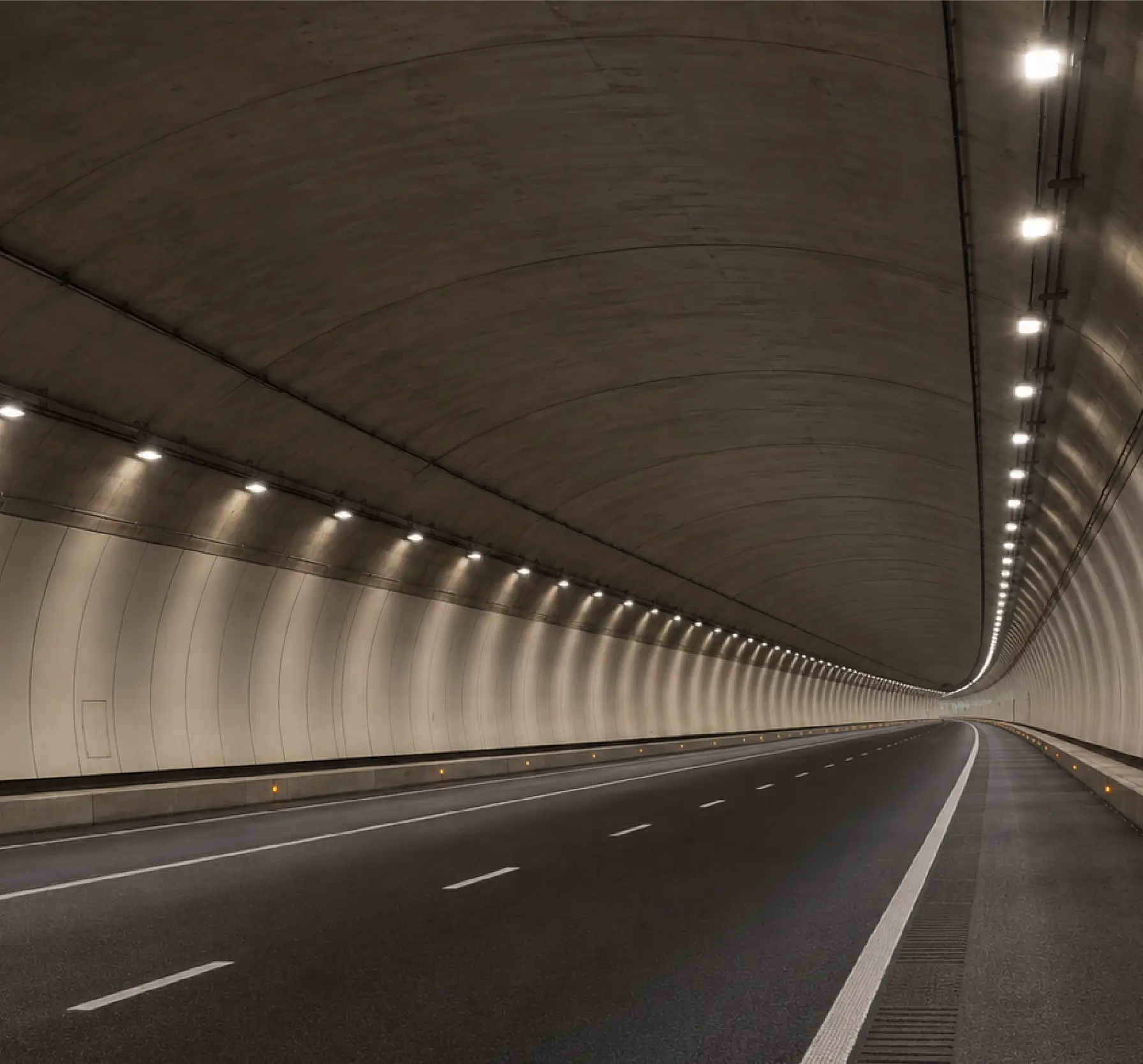
Understanding Tunnel Lighting Zones: Threshold, Transition, Interior & Exit
Modern road tunnels demand more than adequate illumination—they require carefully planned lighting that adapts to changing visual conditions and supports safe driving throughout the journey. Understanding the threshold, transition, interior, exit lighting zones is essential for designing tunnels that minimise visual discomfort, improve driver confidence, and comply with tunnel lighting design standards. This guide explains how each lighting zone functions, the key principles behind effective tunnel illumination, and the role of modern LED tunnel lighting solutions in creating safer and more energy-efficient infrastructure.
What Is Tunnel Lighting?
Tunnel lighting is a specialised illumination system designed to provide safe, consistent visibility for motorists travelling through enclosed roadways. Unlike conventional street lighting, tunnel lighting accounts for the rapid changes in ambient light that drivers experience when entering and exiting a tunnel. A well-designed system uses varying light levels across different tunnel zones to support visual adaptation, minimise glare, and maintain clear visibility of the road, vehicles, pedestrians, and obstacles. Modern underground tunnel lighting combines high-performance LED luminaires, intelligent controls, and carefully planned optics to deliver reliable roadway tunnel lighting solutions that improve safety while reducing energy consumption and maintenance requirements.
Why Tunnel Lighting Zones Matter for Road Safety?
Tunnel lighting zones are designed to support the natural adaptation of the human eye as drivers move between daylight and the enclosed tunnel environment. Without appropriate lighting transitions, motorists may experience temporary vision impairment, reduced reaction times, or difficulty identifying obstacles, particularly at tunnel entrances and exits. Properly designed tunnel illumination safety guidelines help create a safer driving experience while ensuring compliance with recognised tunnel lighting design standards.
Key benefits include:
- Reduces the black hole effect at tunnel entrances by providing adequate threshold illumination.
- Supports gradual visual adaptation through controlled lighting transitions.
- Improves visibility of road markings, vehicles, pedestrians, and potential hazards.
- Enhances driver comfort and confidence throughout the tunnel journey.
- Enables energy efficient tunnel lighting by varying illumination levels according to tunnel zones and ambient daylight conditions.
- Forms the foundation of reliable tunnel lighting solutions for modern transport infrastructure.
Main Tunnel Lighting Zones Explained
| Tunnel Lighting Zone | Purpose | Lighting Characteristics |
| Threshold Zone | Helps drivers adapt from bright daylight to the darker tunnel environment while overcoming the black hole effect. | Highest illumination levels during daytime, adjusted according to outside luminance and tunnel orientation. |
| Transition Zone | Allows the driver's eyes to gradually adjust to lower light levels after entering the tunnel. | Lighting intensity is progressively reduced in stages to ensure comfortable visual adaptation. |
| Interior Zone | Maintains consistent visibility throughout the main length of the tunnel under stable lighting conditions. | Uniform illumination with controlled glare, good colour rendering, and optimised energy usage for continuous operation. |
| Exit Zone | Supports the driver's transition from the tunnel environment back to daylight. | Lighting levels are carefully managed to minimise visual discomfort and maintain clear visibility until the driver exits the tunnel. |
Threshold Zone Lighting in Tunnels
The threshold zone is the first section of a tunnel that drivers encounter when entering from daylight. During the day, the significant difference in brightness between the outside and the tunnel interior can create the black hole effect, making it difficult to distinguish objects inside the tunnel. This zone, therefore, requires the highest lighting levels, with illumination adjusted based on factors such as ambient daylight, tunnel orientation, traffic speed, and stopping distance.
Effective lighting in the threshold zone is fundamental to safe tunnel lighting solutions and forms a critical part of tunnel lighting design guidelines.
Key considerations include:
- High initial illumination to overcome the black hole effect
- Lighting levels based on outside luminance and design speed
- Uniform light distribution with minimal glare
- Durable LED luminaires capable of continuous operation and reliable performance
Transition Zone Lighting in Tunnels
The transition zone follows the threshold zone, enabling drivers' eyes to gradually adapt to the lower illumination levels within the tunnel. Instead of an abrupt reduction in brightness, lighting levels are progressively decreased over a defined distance based on traffic speed and visual adaptation requirements. This controlled reduction helps maintain clear visibility of the roadway, vehicles, lane markings, and potential hazards while improving driving comfort. Modern energy-efficient tunnel lighting systems use adaptive controls to adjust lighting levels in this zone according to changing daylight conditions, reducing energy consumption without compromising safety.
Key considerations include:
- Gradual reduction in lighting levels to support visual adaptation.
- Uniform illumination with controlled glare throughout the zone.
- Adaptive lighting based on ambient daylight and traffic conditions.
- Integration with a tunnel lighting control system for efficient, responsive operation.
Interior Zone Lighting in Tunnels
The interior zone extends through the main length of the tunnel, where drivers have fully adapted to the enclosed environment. The objective in this zone is to provide consistent, uniform illumination that ensures clear visibility without unnecessary brightness or glare. Lighting levels are maintained in accordance with tunnel lighting design standards, allowing drivers to easily identify road markings, signage, vehicles, pedestrians, and potential obstacles. Since luminaires in this section operate for extended periods, high-performance LED systems play a crucial role in delivering reliable illumination while reducing operational costs.
Well-designed roadway tunnel lighting solutions also prioritise long service life and low maintenance to support uninterrupted tunnel operations.
Key considerations include:
- Uniform lighting with controlled luminance and minimal glare.
- Clear visibility of the roadway, signage, and obstacles.
- High-efficiency LED luminaires for continuous operation.
- Durable lighting systems designed for low maintenance and long service life.
Exit Zone Lighting in Tunnels
The exit zone prepares drivers for the transition from the controlled tunnel environment back to natural daylight. Although the visual contrast is generally less severe than at the entrance, sudden exposure to bright outdoor conditions can still affect visual comfort and perception.
Properly designed lighting in this zone supports a smooth visual adjustment, helping drivers maintain awareness of the roadway and surrounding traffic until they have completely exited the tunnel. Modern smart lighting for highway tunnels can dynamically adjust illumination levels in the exit zone based on changing daylight conditions, improving both safety and energy efficiency.
Key considerations include:
- Gradual adaptation from tunnel lighting to natural daylight.
- Consistent visibility of the roadway, vehicles, and signage near the tunnel exit.
- Adaptive lighting control based on ambient daylight conditions.
- Smooth integration with the overall tunnel lighting control system for efficient operation.
Daytime vs Night-Time Tunnel Lighting Requirements
| Aspect | Daytime Operation | Night-Time Operation |
| Entrance Lighting | High illumination is required to overcome the black hole effect and support rapid visual adaptation. | Lower illumination is sufficient as the contrast between the tunnel and the surroundings is significantly reduced. |
| Threshold Zone | Lighting levels are dynamically adjusted based on outside luminance and weather conditions. | Reduced lighting levels are maintained with minimal adjustment required. |
| Transition Zone | Illumination is progressively reduced to allow smooth eye adaptation. | Shorter or less pronounced transition due to lower ambient contrast. |
| Interior & Exit Zones | Uniform lighting ensures safe visibility while optimising energy use through adaptive controls. | Consistent illumination is maintained at lower levels, improving efficiency without compromising safety. |
Key Factors in Tunnel Lighting Design
- Compliance with tunnel lighting design guidelines and applicable standards
- Traffic speed, stopping distance, and tunnel geometry
- Uniform illumination with effective glare control
- Adaptive lighting based on ambient daylight conditions
- Durable, low-maintenance LED luminaires with high ingress protection
- Integration with intelligent lighting control systems
LED Lighting for Tunnel Applications
LED lighting has become the preferred choice for modern tunnel infrastructure due to its high efficiency, long operational life, and reliable performance in demanding environments.
Compared to conventional lighting technologies, LED tunnel lighting solutions provide superior optical control, uniform illumination, and improved visibility while significantly reducing energy consumption and maintenance requirements. Designed to withstand harsh tunnel conditions, modern LED luminaires also support adaptive lighting strategies that optimise illumination levels based on ambient daylight and traffic conditions, making them ideal for energy-efficient tunnel lighting systems.
Key benefits include:
- High luminous efficacy for lower energy consumption.
- Precise optical distribution for uniform roadway illumination.
- Long service life with reduced maintenance requirements.
- Robust construction with high ingress and impact protection.
- Compatibility with intelligent lighting controls for adaptive operation.
Smart Controls for Tunnel Lighting Systems
Modern tunnel lighting systems leverage intelligent controls to improve safety, operational efficiency, and energy performance by automatically adapting lighting levels to changing conditions.
- Ambient luminance sensors adjust lighting based on outside daylight conditions.
- Adaptive dimming ensures the appropriate illumination across different tunnel zones.
- A centralised tunnel lighting control system enables remote monitoring and real-time management.
- Scheduled lighting profiles optimise energy use during varying traffic periods.
- Fault detection and maintenance alerts minimise downtime and simplify asset management.
- Integration with traffic management and SCADA systems enhances operational coordination.
- Smart controls support smart lighting for highway tunnels by balancing safety, visibility, and energy efficiency.
- Remote diagnostics and performance monitoring improve the long-term reliability of tunnel lighting solutions.
Common Mistakes to Avoid in Tunnel Lighting Design
Avoiding common design mistakes is essential to ensure safe, efficient, and reliable tunnel operation.
- Providing insufficient illumination in the threshold zone leads to the "black hole effect."
- Abrupt changes in lighting levels hinder driver visual adaptation.
- Poor luminaire placement results in uneven illumination and glare.
- Ignoring maintenance factors such as accessibility, durability, and ingress protection.
- Overlooking adaptive lighting controls leads to unnecessary energy consumption.
- Selecting luminaires with unsuitable optical distributions for tunnel geometry.
- Failing to comply with tunnel illumination safety guidelines and recognised industrial tunnel lighting best practices.
- Neglecting periodic performance assessments to maintain consistent lighting quality over the system's lifecycle.
Crompton Tunnel Lighting Solutions for Infrastructure Projects
Crompton's tunnel lighting solutions are engineered to deliver safe, reliable, and energy-efficient illumination for modern road and highway tunnels. Designed for demanding operating conditions, Crompton's tunnel luminaires combine high-performance optics, robust construction, and intelligent control compatibility to support every stage of tunnel illumination—from the threshold zone to the exit. These roadway tunnel lighting solutions are built to meet evolving infrastructure requirements while enabling lower maintenance costs and enhanced operational efficiency.
Featured Product – Alphaeca Tunnel Luminaire
- High-performance LED luminaire for tunnel lighting for highways and urban tunnels.
- Available with symmetric, asymmetric and double-asymmetric optics for precise light distribution.
- Up to 190 lm/W efficacy for energy efficient tunnel lighting.
- IP66 and IK10 rated for reliable operation in harsh tunnel environments.
- Compatible with wired and wireless adaptive control systems for intelligent lighting management.
- Adjustable mounting for accurate on-site optical alignment and optimal performance.
Tunnel Lighting Design Checklist
- Define lighting requirements for the threshold, transition, interior, and exit zones.
- Design illumination levels in accordance with applicable tunnel lighting design standards.
- Select LED luminaires with appropriate optical distributions for the tunnel geometry.
- Ensure uniform illumination while minimising glare and dark spots.
- Incorporate adaptive lighting controls based on ambient daylight conditions.
- Choose luminaires with high IP and IK ratings for long-term durability.
- Plan for easy maintenance access and long service life.
- Verify compliance with relevant tunnel illumination safety guidelines before commissioning
FAQs on Tunnel Lighting Zones
Q. What are the different tunnel lighting zones?
A.Tunnel lighting is divided into four zones: the threshold, transition, interior, and exit zones. Each zone is designed to support the driver's visual adaptation, ensuring safe visibility from the moment a vehicle enters the tunnel until it exits.
Q. Why is tunnel lighting divided into threshold, transition, interior and exit zones?
A. These zones allow drivers' eyes to gradually adapt to changing brightness levels, reducing glare, improving visibility, and enhancing overall road safety. The zonal approach also supports efficient energy management and compliance with established tunnel lighting practices.
Q. What is the purpose of the threshold zone in tunnel lighting?
A. The threshold zone provides the highest illumination during daytime to overcome the "black hole effect." It helps drivers clearly identify the roadway, lane markings, vehicles, and potential hazards before entering the tunnel.
Q. How does transition zone lighting help drivers adjust inside a tunnel?
A. The transition zone gradually reduces illumination levels, allowing the human eye to comfortably adapt to the lower brightness within the tunnel without affecting visibility or driving confidence.
Q. What is the recommended lighting level for tunnel interiors?
A. There is no single recommended value, as lighting levels depend on tunnel length, traffic speed, ambient conditions, and applicable tunnel lighting design standards. The objective is to provide uniform illumination with controlled glare and clear visibility throughout the interior zone.
Q. Why is exit zone lighting important in tunnel design?
A. Exit zone lighting helps drivers transition smoothly from the controlled tunnel environment back to natural daylight. It maintains visual comfort and awareness until drivers have completely exited the tunnel.
Q. How does proper tunnel lighting improve road safety?
A. Properly designed LED tunnel lighting solutions improve visibility, support quicker hazard detection, reduce driver fatigue, and enhance overall driving confidence. Combined with energy-efficient tunnel lighting systems, they also lower operating costs while ensuring reliable, long-term tunnel performance.


