


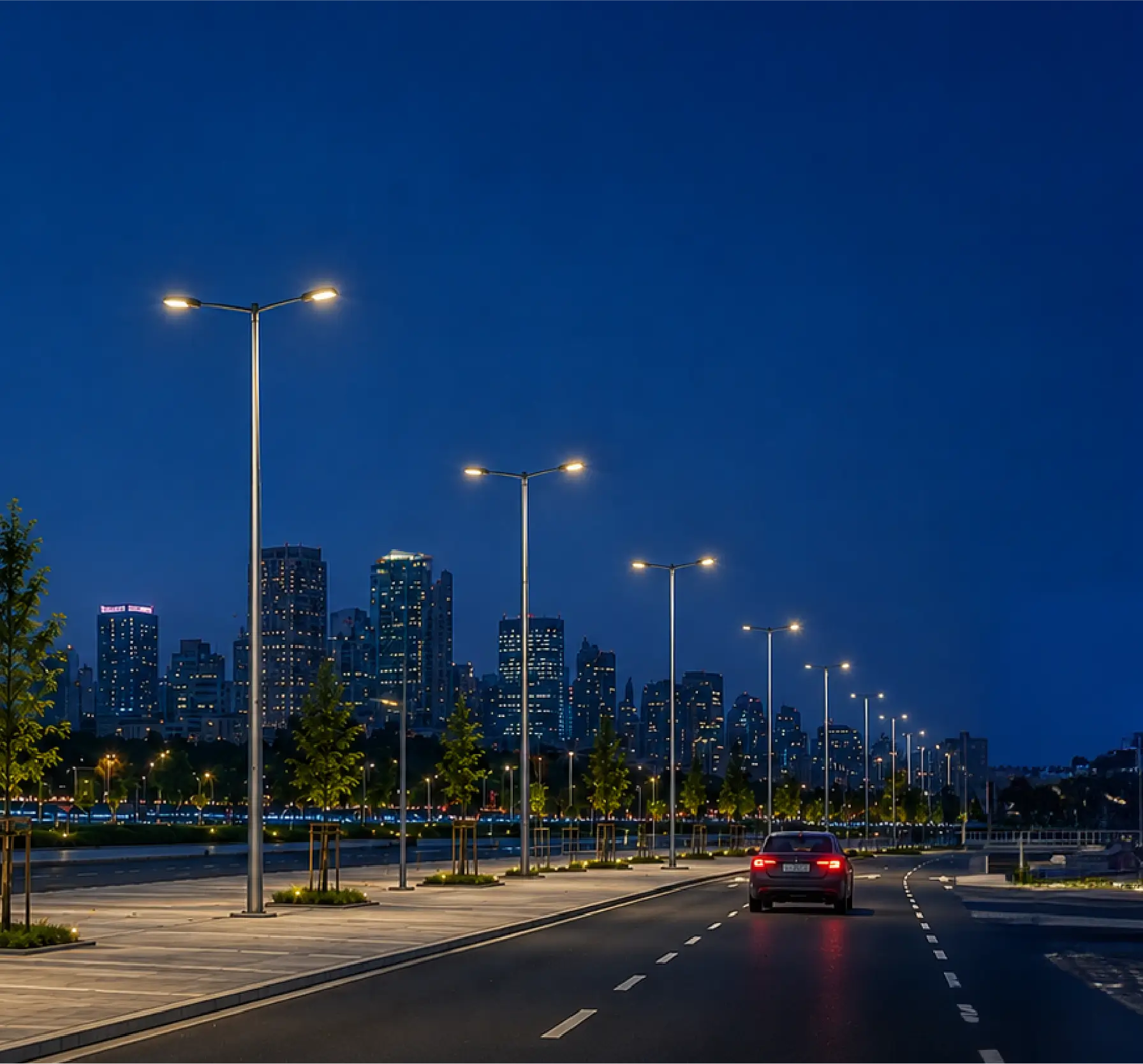
The Future of Smart Street Lighting
As cities embrace digital transformation, smart street lighting is becoming a cornerstone of modern urban infrastructure. By integrating LED smart street lights, intelligent controls, and IoT connectivity, these systems deliver improved visibility, lower energy consumption, and simplified maintenance. The future of smart street lighting lies in creating adaptive, data-driven lighting networks that enhance road safety, optimize operational efficiency, and support sustainable urban development through smart street lighting solutions.
What Is Smart Street Lighting?
Smart street lighting is an advanced lighting system that combines LED luminaires with intelligent controls, sensors, and communication technologies to optimize outdoor illumination. Unlike conventional lighting, IoT-enabled street lights can monitor performance, adjust brightness based on real-time conditions, and report faults remotely. As a key component of smart city lighting infrastructure, these systems improve visibility, reduce energy consumption, and simplify maintenance. Combined with LED street lighting solutions, they deliver reliable illumination for highways, roads, public spaces, and urban environments.
Why Smart Street Lighting Matters for Modern Cities
Urban infrastructure requires lighting systems that are efficient, reliable, and capable of supporting connected environments. Smart street lighting solutions help reduce energy usage while improving safety and operational efficiency through automation and centralized monitoring.
The key benefits include:
- Better road safety with consistent illumination
- Lower power consumption through adaptive lighting
- Remote monitoring for faster fault detection
- Improved efficiency with intelligent street lighting management.
- Support for sustainable energy-efficient street lighting systems.
How Smart Street Lighting Works
Modern smart street lighting solutions combine LED luminaires with sensors, communication gateways, and cloud-based management platforms. These systems collect real-time data to automate lighting, monitor performance, and simplify maintenance.
The key components include:
- LED smart street lights for efficient illumination
- Motion and daylight sensors
- IoT communication modules
- Centralized monitoring software
- Automated fault alerts and diagnostics
Key Technologies Shaping the Future of Street Lighting
- IoT-enabled street lights for real-time connectivity
- Motion and occupancy sensors for adaptive lighting
- AI-based analytics for predictive maintenance
- Wireless communication networks
- Cloud-based intelligent street lighting management
- High-efficacy LEDs delivering higher efficacy
- Modular luminaires for simplified maintenance
- GIS-enabled asset management
Benefits of Smart Street Lighting for Municipal and Government Projects
- Remote Monitoring & Control – Manage lighting networks from a central platform
- Adaptive Energy Savings – Automatically adjusts lighting levels based on usage patterns and schedules
- Predictive Maintenance – Detects faults in real time, reducing downtime and maintenance costs
- Improved Operational Efficiency – Enables faster issue resolution and streamlined asset management
- Data-Driven Decision Making – Generates actionable insights on energy consumption and system performance
- Smart City Integration – Creates a connected lighting infrastructure that supports future urban applications
Smart Street Lighting vs Conventional Street Lighting
| Feature | Smart Street Lighting | Conventional Lighting |
| Energy Use | Adaptive and optimized | Fixed consumption |
| Monitoring | Remote and real time | Manual inspection |
| Maintenance | Predictive | Reactive |
| Brightness | Automatic control | Fixed output |
| Fault Detection | Instant alerts | Physical inspection |
| Integration | Supports smart city street lighting | Standalone systems |
Role of LED Lighting in Smart Street Lighting Systems
LED technology forms the backbone of smart outdoor lighting solutions, delivering superior efficiency, longer service life, and dependable illumination. High-performance LED street lighting solutions also integrate seamlessly with intelligent controls.
The key advantages of LEDs include:
- Higher Efficacy
- Uniform light distribution
- Reduced energy consumption
- Longer operational life
- Lower maintenance requirements
Smart Controls and Adaptive Lighting for Roads and Public Spaces
Smart controls automatically adjust lighting based on traffic movement, pedestrian activity, or ambient conditions. Combined with connected urban lighting technology, they help optimize energy use while maintaining safe lighting levels.
Key capabilities:
- Automatic dimming
- Motion-based lighting
- Remote scheduling
- Fault monitoring
- Energy optimization
Smart Street Lighting Applications Across Urban Infrastructure
| Application | Key Benefit |
| Highways | Adaptive lighting based on traffic density |
| Expressways | Centralised monitoring and fault detection for uninterrupted operation |
| Urban Roads | Smart dimming and scheduling to optimise energy consumption |
| Residential Areas | Motion-based lighting to enhance security while reducing energy use |
| Parks & Public Spaces | Occupancy-based lighting for pedestrian comfort and operational efficiency |
Challenges in Implementing Smart Street Lighting
- High initial investment
- Integration with existing infrastructure
- Reliable communication networks
- Cybersecurity considerations
- Technology standardization
- Selecting durable smart street lighting solutions with surge protection and easy maintenance
How to Choose the Right Smart Street Lighting Solution
Step 1: Define your project objectives, such as energy savings, remote monitoring, adaptive lighting, or smart city integration.
Step 2: Choose a solution with a scalable IoT-enabled lighting management system that supports centralised control and real-time monitoring.
Step 3: Ensure the luminaires support smart controls such as dimming, scheduling, occupancy sensing, or daylight sensing.
Step 4: Select durable, high-performance LED luminaires with appropriate IP and IK ratings for the installation environment.
Step 5: Look for a modular design that simplifies maintenance and future upgrades.
Step 6: Verify compliance with BIS and other relevant standards to ensure long-term reliability and quality.
Crompton Smart Street Lighting Solutions for Future-Ready Infrastructure
Crompton's smart street lighting solutions combine intelligent controls with high-performance LED technology to deliver reliable illumination, improved energy efficiency, and simplified maintenance across roads, highways, and urban infrastructure.
Key features include:
- LED efficacy up to 140 lm/W
- BIS-certified components
- Modular design with separate driver compartment
- Sensor-enabled automation for intelligent outdoor lighting
- Internal surge protections up to 4kV and 10kV SPD.
- High IPand IK rated construction
Smart Street Lighting Checklist for Urban Projects
- High-efficiency LED luminaires
- IoT-enabled lighting management and controls
- Support for adaptive dimming and sensor integration
- Remote monitoring and fault diagnostics
- Durable, weather-resistant construction for outdoor use
- Modular, maintenance-friendly design
- Compliance with relevant quality and safety standards
FAQs on Smart Street Lighting
Q. What is the future of smart street lighting?
A. The future involves connected, adaptive lighting systems powered by IoT, automation, and LEDs to improve efficiency, safety, and sustainability.
Q. How does smart street lighting work?
A. It uses LEDs, sensors, communication networks, and centralized software to monitor, control, and optimize lighting in real time.
Q. What are the benefits of smart street lights?
A. They reduce energy consumption, improve visibility, lower maintenance costs, and support efficient lighting management.
Q. How can smart street lighting reduce energy consumption?
A. Adaptive controls automatically adjust brightness based on traffic, pedestrian activity, and daylight conditions.
Q. What technologies are used in smart street lighting systems?
A. Common technologies include IoT-enabled street lights, wireless communication, cloud platforms, AI analytics, and LED street lighting solutions.
Q. How does IoT improve street lighting management?
A. IoT enables remote monitoring, predictive maintenance, centralized control, and instant fault notifications.
Q. Why are cities adopting smart street lighting solutions?
A. Cities are implementing smart street lighting solutions to improve public safety, reduce operational costs, enhance energy efficiency, and strengthen smart city street lighting infrastructure.


