


Why Is Lifecycle Cost More Important Than Upfront Cost in Industrial Lighting?
When selecting lighting for an industrial facility, the initial purchase price is often one of the first factors businesses consider. However, focusing only on upfront cost can overlook the expenses that continue throughout the life of a lighting system.
Industrial lighting operates for long hours and often works in demanding environments such as factories, warehouses, production facilities, workshops, and processing plants. In these settings, energy consumption, maintenance, replacement frequency, and downtime can have a significant impact on the overall cost of ownership.
This is why businesses need to look beyond the purchase price and evaluate the lifecycle cost of industrial lighting. A lighting system that costs more initially may deliver greater savings and better operational value over its entire service life.
What Is Lifecycle Cost in Industrial Lighting?
Lifecycle cost refers to the total cost associated with owning and operating a lighting system throughout its useful life. It goes beyond the price paid to purchase the fixture.
A typical lifecycle cost calculation includes:
- Initial purchase cost
- Installation costs
- Electricity and energy consumption
- Routine maintenance
- Replacement components
- Labor costs
- Downtime associated with failures or maintenance
- Disposal or recycling costs
Looking at all these factors provides a more accurate picture of what a lighting system will actually cost a business over several years.
For industrial facilities, this approach is particularly important because lighting may operate for thousands of hours every year. Even a small difference in energy consumption can become significant when multiplied across hundreds or thousands of fixtures.
Why Is Lifecycle Cost Important in Industrial Lighting?
The initial purchase price represents only a small part of what businesses spend on lighting over time.
Consider two industrial lighting systems. One has a lower purchase price but consumes more electricity and requires frequent maintenance. The other costs more initially but uses less energy, lasts longer, and requires fewer replacements.
The first option may appear cheaper during procurement. However, after several years of energy and maintenance expenses, it could cost considerably more.
Lifecycle costing helps facility managers and procurement teams evaluate lighting based on its long-term financial and operational impact, rather than simply selecting the lowest-priced product.
Why Consider Lifecycle Cost in Industrial Lighting?
There are several reasons businesses should consider lifecycle cost in industrial lighting before making a purchasing decision.
Energy Costs Continue Every Day
The purchase of a lighting fixture is a one-time expense, but electricity is a recurring expense.
Industrial facilities may operate lighting for extended shifts, sometimes around the clock. This makes energy efficiency an important consideration when selecting lighting systems.
A fixture with higher energy efficiency can reduce electricity consumption over its operating life. When hundreds of fixtures are installed across a large facility, these savings can become substantial.
Maintenance Adds to the Total Cost
Lighting maintenance involves more than the cost of replacement lamps or components. Businesses may also need to account for technician time, equipment required to access fixtures, and operational disruption.
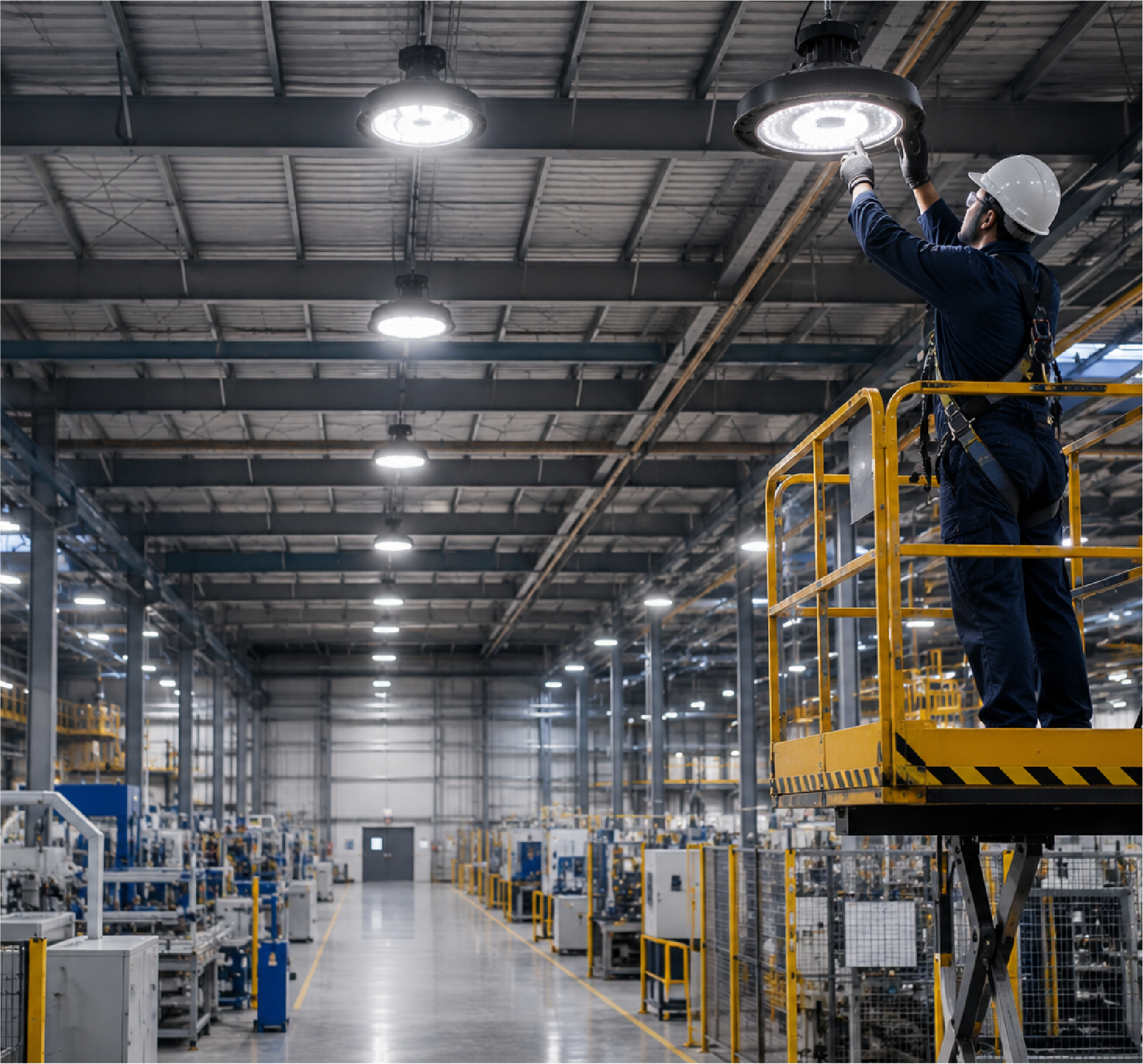
For example, replacing fixtures installed at significant heights may require lifts or specialised equipment. In a warehouse or manufacturing facility, maintenance may also need to be scheduled around production activities.
A longer-lasting lighting system can reduce the frequency of these interventions and help lower ongoing maintenance costs.
Frequent Replacement Can Increase Labour Costs
A low-cost lighting product may require more frequent replacement. Every replacement requires time and labour.
In a large industrial facility, replacing hundreds of fixtures can become a significant operational task. Choosing durable lighting with a longer service life can reduce the number of replacements required over the facility's operating period.
Downtime Has a Cost
Lighting failures can affect more than maintenance budgets.
In manufacturing and industrial environments, poor or inadequate lighting can affect visibility, workflow, safety, and productivity. If maintenance requires access to operational areas, it can also cause interruptions.
A reliable lighting system can help reduce unexpected failures and minimise the disruption associated with maintenance.
Consider Energy Costs for Long-Term Savings
Why consider energy costs when choosing industrial lighting? Because energy is one of the most important recurring expenses associated with operating a lighting system.
When comparing lighting options, businesses should consider factors such as:
- Fixture wattage
- Number of operating hours
- Number of fixtures installed
- Electricity rates
- Lighting controls
- Expected service life
- Required illumination levels
For example, replacing a large number of older, inefficient fixtures with modern LED systems can reduce the amount of electricity required to provide the same level of illumination.
The potential savings become even more meaningful in facilities with long operating schedules.
Smart controls can also improve efficiency. Occupancy sensors, scheduling, daylight harvesting, and zoning can help ensure that lighting operates only when and where it is required.
Lifecycle Cost Matters Beyond Upfront Price
Why does lifecycle cost matter more than upfront cost? Because the cheapest product to purchase is not necessarily the cheapest product to own.
Imagine a facility comparing two lighting options:
|
Cost Factor |
Option A: Lower Upfront Cost |
Option B: Higher Efficiency |
|
Purchase price |
Lower |
Higher |
|
Energy consumption |
Higher |
Lower |
|
Maintenance |
More frequent |
Less frequent |
|
Replacement frequency |
Higher |
Lower |
|
Downtime risk |
Potentially higher |
Potentially lower |
|
Long-term cost |
Potentially higher |
Potentially lower |
The exact savings will depend on the facility, operating hours, electricity rates, product specifications, and installation conditions. However, the example illustrates why purchase price alone does not provide a complete financial picture.
A higher initial investment can sometimes be justified when the product delivers lower energy consumption, longer service life, reduced maintenance, and better reliability.
The Hidden Costs of Choosing the Cheapest Lighting
Choosing lighting based solely on price can create several hidden costs.
Higher Energy Consumption
A less efficient fixture may consume more electricity throughout its operating life, increasing recurring energy expenses.
More Frequent Maintenance
Shorter service life can mean more frequent replacements and higher maintenance requirements.
Installation and Access Costs
Replacing fixtures in high-bay warehouses, production floors, or difficult-to-access areas can require specialised equipment and additional labour.
Operational Disruption
Repeated failures or maintenance activities can interfere with normal operations, particularly in facilities that operate continuously.
Inconsistent Lighting Performance
Frequent failures or declining lighting performance can create uneven illumination, affecting visibility and the working environment.
These costs may not appear on the initial purchase order, but they contribute to the actual cost of owning the lighting system.
How to Calculate the Lifecycle Cost of Industrial Lighting
Businesses can use a straightforward framework to compare different lighting solutions.
Lifecycle Cost = Purchase Cost + Installation Cost + Energy Cost + Maintenance Cost + Replacement Cost + Disposal Cost
For a more accurate comparison, businesses should also consider the expected operating hours and useful life of the lighting system.
For example, if one lighting system has a lower purchase price but consumes significantly more electricity every year, its lifecycle cost may eventually exceed that of a more efficient system.
A lifecycle analysis can therefore help procurement teams justify an investment based on measurable long-term value rather than simply the initial price.
What Should Businesses Evaluate Before Choosing Industrial Lighting?
Before selecting an industrial lighting system, businesses should consider more than fixture price.
Energy Efficiency
Evaluate how much energy the fixture consumes while providing the required illumination.
Service Life
Consider the expected operating life and how frequently components may need to be replaced.
Maintenance Requirements
Look at how easily the fixtures can be inspected, serviced, and replaced.
Operating Environment
Industrial facilities can expose lighting to dust, moisture, heat, vibration, chemicals, and other demanding conditions. Lighting should be suitable for the specific environment.
Lighting Controls
Consider whether sensors, dimming, scheduling, or other controls can improve energy efficiency.
Warranty and Reliability
A suitable warranty and dependable product performance can reduce financial and operational risks over the long term.
Total Cost of Ownership
Finally, compare all expected costs rather than focusing only on the initial purchase price.
Making Lighting Decisions Based on Long-Term Value
Industrial lighting should be viewed as part of a facility's long-term infrastructure. Once installed, lighting systems can influence energy bills, maintenance schedules, operational reliability, and workplace conditions for years.
This is why lifecycle costing is valuable. It helps businesses make decisions based on the total value a lighting system provides throughout its useful life.
A lighting solution with a higher upfront cost may be the better investment if it delivers lower energy consumption, fewer replacements, reduced maintenance, and reliable performance.
Conclusion
The real cost of industrial lighting goes beyond the purchase price. Energy, maintenance, replacement, installation, and downtime all affect total ownership costs. By considering these factors, businesses can choose lighting solutions that deliver better long-term efficiency, reliability, and value. Ultimately, the lowest upfront cost isn't always the most cost-effective choice.


