


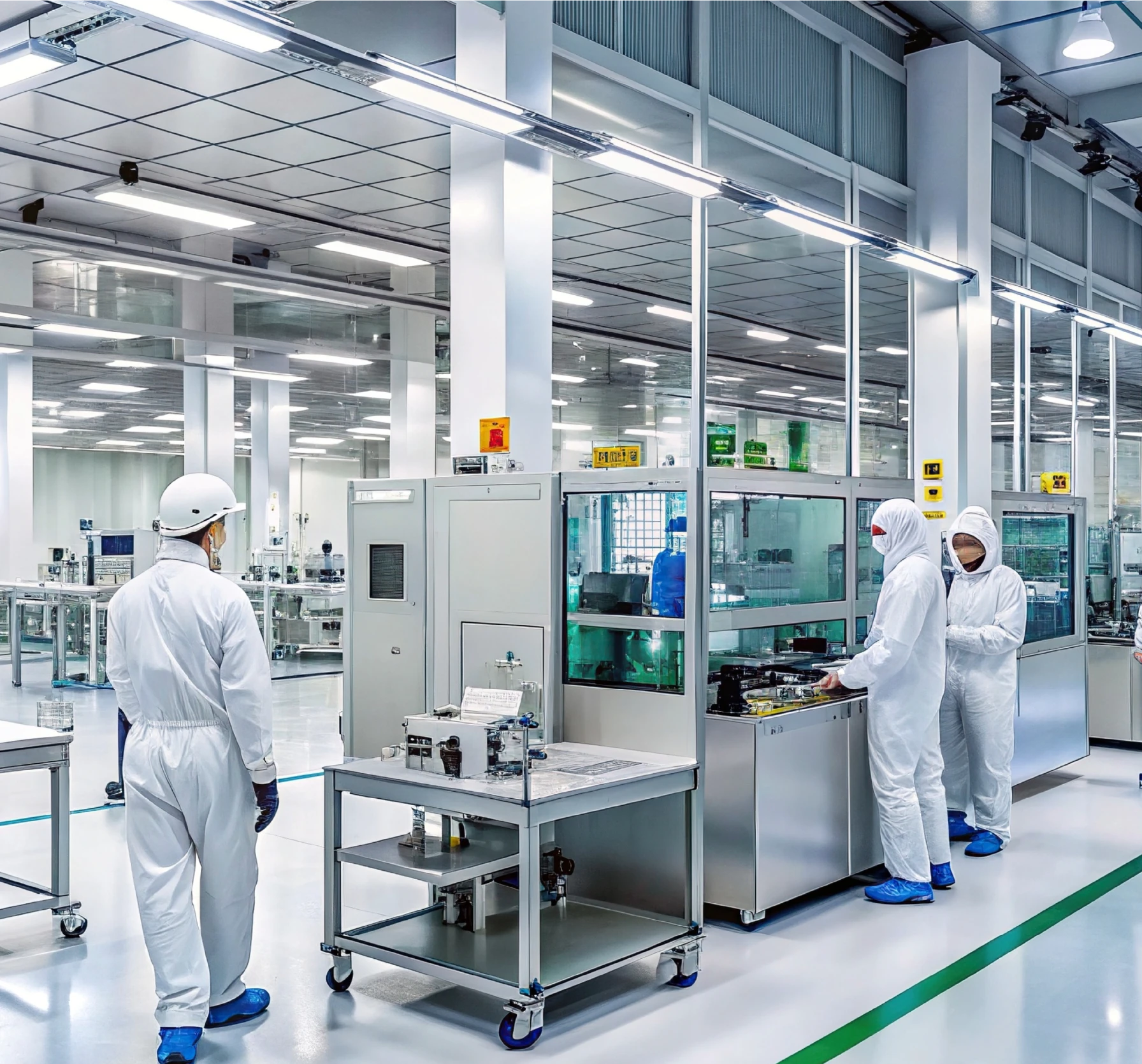
New lighting concepts in the Electronics & Semiconductor Industry
The electronics and semiconductor sector demands lighting solutions that deliver exceptional precision, reliability, and cleanliness while supporting energy efficiency and operational excellence. Modern lighting for semiconductor industry applications goes beyond simple illumination by integrating smart controls, cleanroom-compatible luminaires, and energy-efficient LED technologies. From contamination-free environments to precision inspection areas,
next-gen lighting technologies for electronics industry are helping manufacturers improve product quality, reduce defects, optimise energy consumption, and create safer, more productive workspaces.
Why Lighting Matters in Electronics and Semiconductor Facilities?
Lighting plays a critical role in ensuring precision, quality, and operational efficiency across electronics and semiconductor facilities. From cleanrooms and assembly lines to inspection stations, the right electronics manufacturing lighting enhances visual accuracy, minimises errors, and supports contamination-controlled environments. Modern semiconductor industry lighting combines high-quality LED luminaires, uniform light distribution, and intelligent controls to improve productivity while reducing energy consumption and maintenance costs. As manufacturing processes become increasingly sophisticated, selecting the right lighting solution is essential for maintaining product quality, worker safety, and long-term operational reliability.
Key Lighting Requirements for Semiconductor Manufacturing Units
Semiconductor manufacturing environments demand lighting solutions that support precision, cleanliness, safety, and uninterrupted operations. The core technical and design requirements include:
- Uniform Illumination: Consistent, shadow-free lighting across assembly lines and processing bays to ensure absolute quality and visual precision
- Low Contamination Design: Fixtures engineered with smooth, sealed surfaces to prevent dust, microbial elements, or airborne particles from settling, strictly maintaining sanitary conditions
- Task-Specific Brightness: Delivery of optimised, localised lux levels required for intricate manufacturing tasks to maximise accuracy and minimise defects
- Easy Integration with Airflow: Low-profile, aerodynamic luminaire shapes that seamlessly facilitate cleanroom laminar airflow without causing air turbulence or compromising sterility
- High Colour Rendering Index (CRI): High CRI performance is essential for distinguishing components and sub-micron markings accurately, where precise colour differentiation directly impacts yield rates
- Flexible Maintenance Options: Adaptable mechanical configurations (such as top-opening or bottom-opening designs) that ensure cleaning, component replacement, or routine servicing occurs without risking cleanroom contamination
- Flicker-Free Lighting: Regulated power drivers to minimise visual fatigue, worker eye strain, and inspection errors
- Glare-Controlled Luminaires: Specialised internal optics and diffusers to maximise visual comfort during prolonged operator shifts
- ESD-Compatible Fixtures: Anti-static engineering designed specifically to discharge static buildup safely within controlled production environments
- Energy-Efficient Smart Systems: Integration of automated scheduling and sensor controls to drop overhead operating costs
Cleanroom Lighting for Electronics and Semiconductor Facilities
Cleanrooms are the core of high-tech fabs, where sub-micron particles compromise yields. Implementing advanced LED cleanroom lighting solutions is vital to maintaining strict particulate criteria required by ISO 14644-1 standards. These contamination-free lighting solutions for semiconductor plants feature smooth, sealed profiles that prevent dust accumulation and integrate seamlessly with laminar airflow systems without causing turbulence.
- TOCR Architecture: Top Opening configurations allow servicing from above the ceiling grid, ensuring zero manufacturing downtime in high-sensitivity zones
- BOCR Engineering: Bottom-opening systems offer fast, localised internal maintenance via wishbone frame alignments
- Ingress Protection: Robust IP65 or IP66 ratings safeguard circuitry from rigorous chemical washdown procedures
LED Lighting for Precision Manufacturing and Inspection Areas
High-precision electronic assembly requires extreme visual accuracy. Defect detection, microscopic microchip inspection, and quality control lines rely entirely on high-precision electronic industry lighting to reveal surface anomalies.
- High CRI: True colour rendering optimises contrast for micro-soldering and sub-micron wafer testing
- Monochromatic Output: Employs precise yellow LED lighting for semiconductor plants to eliminate short ultraviolet and blue wavelengths that trigger chemical reactions in photolithography layers
- Flicker-Free Performance: Steady power regulation eliminates stroboscopic effects, preventing visual fatigue during extended operator inspection shifts
Smart Lighting Controls for Semiconductor Facilities
Smart lighting systems help semiconductor facilities optimise energy use, improve operational efficiency, and simplify lighting management through intelligent automation and connected controls.
- Centralised Management: Integrates automated smart lighting for semiconductor facilities into localised networks for remote diagnostics
- Automated Dimming: Leverages high-sensitivity occupancy and daylight harvesting sensors to automatically scale lux levels down based on occupancy across smart lighting for semiconductor fabs
- BMS Synchronisation: Connects seamlessly with primary Building Management Systems to export real-time power analytics
- Predictive Maintenance: Provides data-driven insights to log runtime hours and schedule fixture servicing ahead of component failures
- Flexible Scheduling: Implements time-based profiles matching shift rotations, preventing unoccupied areas from drawing power while ensuring continuous baseline visibility
Human-Centric Lighting for Electronics Manufacturing Workspaces
Electronics manufacturing requires employees to perform detailed and repetitive tasks for extended periods. Human-centric lighting creates comfortable, well-lit workspaces that reduce visual fatigue, improve concentration, and enhance overall productivity. By delivering balanced illumination with high visual comfort, lighting for electronic industry applications supports both employee well-being and manufacturing accuracy.
Key benefits include:
- Visual Comfort: Smooth, glare-controlled optics eliminate reflective hot spots, minimising headaches and visual fatigue
- Flicker Reduction: Constant-current drivers prevent invisible light pulsing, protecting operator health and maintaining sustained tracking focus
Lighting for ESD-Sensitive and Controlled Production Areas
Electrostatic discharge events represent a constant threat to sub-micron microchip architecture. Specialised layouts require industrial lighting for semiconductor manufacturing that balances premium illumination with comprehensive static protection.
Key requirements include:
- ESD-Safe Engineering: Fixtures feature specialised static-dissipative coatings and grounded paths to prevent charge buildup near sensitive silicon wafers
- Uniform Distribution: Balanced beam angles remove shadows from dense workbench areas, aiding manual component tracking
- Durable Enclosures: Robust mechanical housings protect structural components against impact and airborne chemical outgassing in specialised testing loops
Energy-Efficient Lighting for Semiconductor and Electronics Plants
Energy-efficient lighting helps electronics and semiconductor facilities reduce operating costs while maintaining the high illumination levels required for precision manufacturing and inspection.
- Maximum Source Efficacy: Employs high-lumen-per-watt LED architectures to reduce base power consumption across the facility
- Lower Thermals: Utilising energy-efficient factory lighting for electronics minimises heat dissipation, reducing the mechanical cooling load placed on active HVAC units
- Dimming Optimisation: Pairs high-efficacy luminaires with dynamic dimming schedules to reduce energy usage when workspaces are vacant
- Extended Longevity: Long-life LED modules minimise maintenance interventions, cutting operational replacement costs
- ESG Alignment: Drastically lowers carbon footprints, supporting corporate sustainability metrics and environmental compliance goals
Lighting Applications Across Electronics and Semiconductor Facilities
| Facility Area | Lighting Requirement | Benefit |
| Cleanrooms | Sealed, contamination-resistant LED luminaires | Maintains cleanroom integrity and product quality |
| Assembly Lines | Uniform, glare-free LED lighting | Improves assembly accuracy and operator comfort |
| Precision Inspection Areas | High-CRI, flicker-free lighting | Enables accurate defect detection and quality control |
| Semiconductor Fabrication | Smart lighting for semiconductor fabrication | Optimises energy use and centralised lighting management |
| ESD-Controlled Production Areas | ESD-compatible LED lighting | Protects sensitive electronic components from electrostatic discharge |
| Warehouses & Material Storage | Energy-efficient LED high-bay lighting | Enhances visibility and reduces operating costs |
| Utility Service Areas | Durable industrial LED luminaires | Ensures reliable illumination with minimal maintenance |
Common Lighting Challenges in Semiconductor Facilities
Semiconductor facilities face unique lighting challenges that can directly impact product quality, operational efficiency, and worker productivity.
- Sterility Management: Preventing particle shedding from light housings to keep cleanrooms safe from contamination
- Airflow Disruption: Bulk luminaires blocking laminar air currents, causing turbulent pockets that settle contaminants
- Wavelength Reactivity: Stray UV or blue light spectrums accidentally curing photoresists in photolithography lines
- Static Arc Hazards: Standard housings storing static charges, threatening delicate microchips
- Thermal Overload: Hot running fixtures straining internal HVAC cooling capacity
- Continuous Operations: Maintenance cycles interrupting non-stop production shifts
How to Choose the Right Lighting for Electronics Manufacturing
Step 1: Classify Environmental Standards: Audit individual workspace parameters against cleanroom ISO 14644-1 ratings to identify particle limits.
Step 2: Select the Maintenance Model: Specify Top Opening (TOCR) fixtures for critical cleanrooms to ensure maintenance occurs outside clean zones, avoiding manufacturing stops. Use Bottom Opening (BOCR) designs elsewhere.
Step 3: Analyse Spectral Sensitivity: Isolate photolithography lines and integrate monochromatic yellow LED lighting for semiconductor plants to eliminate reactive UV wavelengths.
Step 4: Enforce Protection Ratings: Verify localised chemical washdown workflows to deploy the correct dust-tight, waterproof IP65 or IP66 enclosures.
Step 5: Implement Automated Systems: Connect sensor-driven controls to a centralised BMS to ensure energy efficient semiconductor lighting operation facility-wide.
Crompton Lighting Solutions for Electronics and Semiconductor Facilities
Crompton offers advanced lighting for semiconductor industry applications, combining
high-performance LED luminaires with intelligent controls to meet the demanding requirements of electronics manufacturing. Designed for cleanrooms, inspection zones, production areas, and utility spaces, our solutions deliver precision, reliability, energy efficiency, and long-term operational performance while supporting modern manufacturing standards.
Our portfolio includes:
- Cleanroom LED Lighting
- High-Bay LED Luminaires - Aquilla Plus & Delphinus Plus
- High-CRI Lighting for Precision Inspection
- SensoRange: Smart Lighting Controls Sensors
- SensoRange SMART: Connected Lighting Management Solutions
- Weatherproof Industrial Lighting
- Emergency Lighting Systems
- BMS-Compatible Intelligent Lighting Solutions
Electronics and Semiconductor Lighting Checklist
Use this checklist to evaluate whether your facility is equipped with a future-ready lighting system:
- High-efficacy LED lighting installed across all production areas
- Cleanroom-compatible, contamination-resistant luminaires in controlled environments
- High CRI, flicker-free lighting for precision inspection and assembly
- Smart lighting controls with occupancy and daylight sensing
- Energy-efficient lighting integrated with BMS
- ESD-compatible lighting for sensitive production areas
- Low-maintenance, long-life luminaires for continuous operations
- Uniform, glare-free illumination throughout the facility
FAQs on Lighting for Electronics and Semiconductor Industry
Q. What are the best lighting solutions for the electronics and semiconductor industry?
A. High-performance LED luminaires, cleanroom lighting, smart controls, and high-CRI fixtures provide the ideal lighting for semiconductor industry and electronics manufacturing applications.
Q. Why is cleanroom lighting important in semiconductor manufacturing?
A. Cleanroom lighting minimises contamination while delivering uniform, glare-free illumination for precision manufacturing and inspection processes.
Q. What type of lighting is used in electronics manufacturing facilities?
A. Electronics manufacturing lighting typically includes high-efficiency LED luminaires, cleanroom lighting, high-bay fixtures, and smart lighting controls.
Q. How does proper lighting improve precision in semiconductor production?
A. Uniform, flicker-free, high-CRI lighting enhances visual accuracy, helping operators identify defects and perform precision tasks more effectively.
Q. What are the key requirements for cleanroom LED lighting?
A. LED cleanroom lighting solutions should offer sealed construction, low particle emission, high CRI, glare control, and consistent illumination.
Q. How can industrial lighting reduce defects in electronics manufacturing?
A. High-quality LED lighting improves visibility and inspection accuracy, reducing errors and supporting consistent product quality.
Q. Why should semiconductor facilities use energy-efficient LED lighting?
A. Energy efficient semiconductor lighting lowers power consumption, reduces maintenance costs, and supports long-term sustainability without compromising lighting performance.


